
Florida's Miami-Dade County has a long history of hurricane activity. In 2005, which turned out to be one of the most active hurricane seasons ever seen in Florida, several storms caused varying degrees of damage to the state. When Hurricane Katrina crossed south Florida, it was a weak Category 1 storm on the Saffir-Simpson Hurricane Scale before it strengthened in the Gulf of Mexico. Hurricane Rita caused minimal flooding in portions of the Florida Keys before also traveling on to the Gulf. However, in October of that year, as Hurricane Wilma approached Florida, Miami-Dade County was not so lucky. As the storm neared the coast, Wilma was classified as a Category 3 on the Saffir-Simpson Hurricane Scale, with maximum sustained winds of 115 mph and hurricane-force winds extending outward 85 miles from the storm's center.
Once Wilma came ashore, according to the National Hurricane Center, most of the southeastern Florida peninsula experienced at least strong Category 1 hurricane conditions. Some parts of northern Miami-Dade County, Broward County and Palm Beach County likely endured Category 2 hurricane conditions.
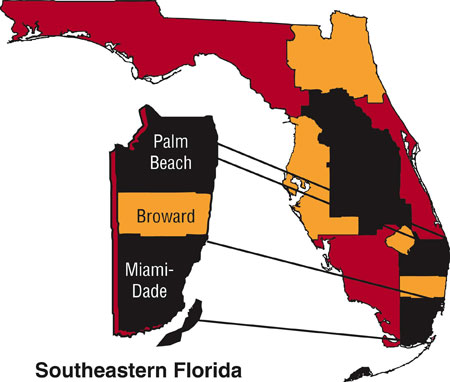
In comparison, the catastrophic damage caused by Hurricane Andrew, which occurred in late August 1992, was limited to south Miami-Dade County. Although major structural damage caused by Wilma was mostly insignificant, because of the storm's size, all portions of Miami-Dade County were affected. Wilma's sustained hurricane-force winds damaged a substantial number of mostly older roof systems, requiring them to be replaced or repaired.
The problem
The building code in effect in Miami-Dade County is the High Velocity Hurricane Zone (HVHZ) portion of the Florida Building Code. This code has evolved since Hurricane Andrew and now incorporates many lessons learned since then. The code's intent is to help ensure life safety and roof system performance during high-wind events.
The Miami-Dade County contractor base is well-acquainted with the requirements of HVHZ as it pertains to roofing. However, with the large volume of roof system repair, replacement and reconstruction work necessary in the aftermath of Wilma, additional help from out-of-town contractors was needed.
As can be expected, these contractors required guidance, information and support from the Miami-Dade County Building Department regarding the requirements of the HVHZ portion of the Florida Building Code as it pertains to roofing.
With such a large volume of roofing permits being issued and inspection activities resulting from Wilma, coordination and communication between the building department and roofing contractors were critical. Telephone calls were not a practicality because of the quantity of inquiries. Also, going to the building department and waiting in long lines for information or forms is an inconvenience at best and not practical, especially for out-of-town contractors.
The solution
Fortunately, the Miami-Dade County Building Department had a solution to this problem. In 1998, the Miami-Dade County Building Department launched a Web site, www.miamidade.gov/building, to help contractors and the public make sense of building code and permitting requirements. The Web site has been continually improved and updated since then to meet the demands following a major storm.
Contractors who use the site can:
Vance Milton, president of Milbar Construction Inc., based in Dade City, Fla., is one contractor who has found the Web site useful.
"We have, for almost 25 years, avoided working in the Miami area because of horror stories about how difficult the Miami-Dade County Building Department is to deal with," he says. "Fortunately, I have found that not to be the case. The Web site has many features that have become valuable tools for our company. For example, one Internet link allows access to track my permit application progress. This enables me to address corrections more efficiently. Additionally, once the permit has been issued, I can set up inspections and track inspectors' progress. I have also taken advantage of e-mailing any questions or concerns I have had and received prompt answers to them."
The electronic permitting process enables a roofing contractor to obtain a residential roofing permit online. Using a secure password, a contractor can submit the permit application and obtain a "W" process number for a Web-based roofing permit. Permit fees are calculated depending on the square footage of the job and type of roofing material to be installed. Once this information is provided, a uniform roofing application is completed for the type of roof system to be installed.
Roofing categories acceptable for the electronic permitting system include any combination of shingles, tile and low-slope built-up roofing. After the appropriate forms have been completed, the permit is reviewed and approved electronically. After approval, the permit is paid for online, and a contractor can print all the required documents. Theoretically, a roofing contractor could sign a contract and obtain a permit by using a laptop with Internet access and a portable printer while still at the job site.
Electronic permitting has proved to be popular with contractors. Between October 2005 and September 2006, 12,019 electronic roofing permits were issued. This represents 30 percent of the total roofing permits issued for this time period.
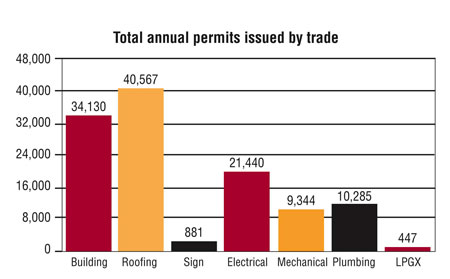
Figure 2: The number of permits issued by Miami-Dade County between October 2005 and September 2006
Another feature that helps contractors is the ability to look up plan review comments. If required information is missing, such as testing or installation details, a contractor can resolve these issues without picking up the permit package first. This is a more efficient method for contractors because the required information or corrections can be resubmitted in one trip to the building department.
The HVHZ requires roof assemblies, components and materials to have Miami-Dade County Product Control Approvals Notices of Acceptance (NOAs). There is an approved products link on the Web site which enables contractors to search all NOAs electronically. Once appropriate product approval documents are selected, they can be printed for submittal with the roofing permit application.
In addition, the ability to request an inspection quickly benefits all. On the building department's Web site, links are provided to request or cancel an inspection once a permit has been issued. The option to cancel an inspection can help avoid an unnecessary re-inspection fee. Contractors can cancel inspections on the same day they are requested between 6 a.m. and 8 a.m.
Coordinating with an inspector and knowing when he will be at a job site is difficult even during the best of times. When using the "Inspector's Route" link on the Web site, a contractor enters his permit number for the inspection he has requested for that day. The site displays the inspector's route, listing all of his stops to be made that day. The inspector's name, telephone number and picture also are provided. (See Figure 1.)
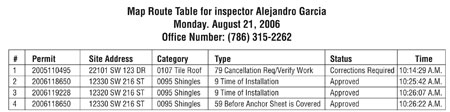
Figure 1: A sample of an inspector's schedule that can be found online
During the day, each inspector's route is continually updated. This makes it easy for contractors to track inspectors' locations throughout the day via the Internet.
The "Inspection History" link enables a contractor to look up the results of any inspection for any given roofing permit. The building department's inspection process allows inspectors to record inspection results on-site using laptop computers. The inspection results then are available immediately on the Web site or through an automated voice response system. These features have improved departmental efficiency and service provided to the public. Knowing the inspection results enables a contractor to correct any deficiencies before recalling a required inspection.
Additionally, contractors can schedule their crews and order materials more efficiently when they know the inspection status of their projects.
The benefits
Since Hurricane Wilma, the Miami-Dade County Building Department issued more than 40,567 roofing permits between October 2005 and September 2006. This has resulted in 261,942 roofing inspections to verify compliance with the HVHZ portion of the Florida Building Code. All these permits had to be submitted, reviewed, approved and inspected, which required close coordination between roofing contractors and building department personnel.
Fortunately, Miami-Dade County was able to meet the challenge presented in the aftermath of Hurricane Wilma. The online services provided by the building department have expedited the permitting and inspection process through the use of advanced technology.
Obviously, providing improved communication and services benefits all concerned, especially with the volume of work necessary after hurricanes.
Boris Sursky is a roofing plans examiner with the Miami-Dade County Building Department.


COMMENTS
Be the first to comment. Please log in to leave a comment.