
 Photo courtesy of TLSmith Consulting Inc., Rockton, Ill.
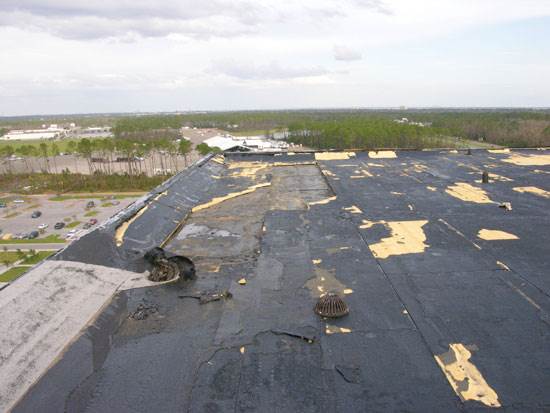 Photo courtesy of FEMA 577.
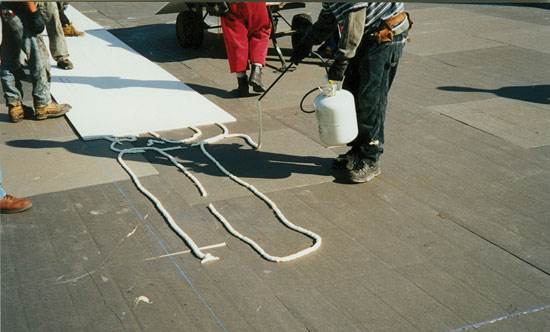 Photo courtesy of TLSmith Consulting.
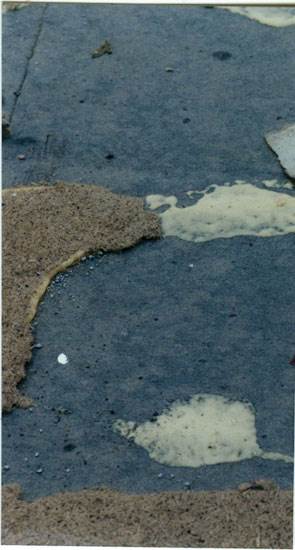 Photo courtesy of TLSmith Consulting.


Since the fall of 2004, much of my work has been related to wind investigations and the writing of wind design guides for the Federal Emergency Management Agency (FEMA). In addition to hurricane investigations, I've also investigated several roofs that have been damaged by other types of storms. The hurricane and non-hurricane investigations have led me to pay particular attention to attachment of insulation, base flashings and rooftop equipment.
Concrete decks
Adhering insulation to cast-in-place concrete is a challenge for designers and contractors. Because of decks' undulating nature, insulation boards can bridge across deck depressions. Although some lack of attachment is expected and not detrimental to wind-uplift resistance, if the unattached area is large, resistance may be impaired (see Photo 1). The following recommendations also apply when a vapor retarder is between a deck and insulation.
Planar flatness is key to achieving adequate attachment over cast-in-place concrete decks. I believe most cast-in-place roof decks are not as flat as desired for fully adhered applications. For new construction, FEMA 577 recommends a planar flatness of a maximum 1/4-inch gap under a 10-foot straight edge be specified when insulation boards are to be adhered to a deck.
Most roof decks probably have planar flatnesses of about 1/2-inch gap under a 10-inch straight edge. Obviously, it takes more effort (and money) to achieve a planar flatness of 1/4 of an inch versus 1/2 of an inch. The 1/2-inch gap is fine for ballasted and mechanically attached systems, so to save money, designers only should specify the 1/4-inch gap requirement when boards are to be fully adhered.
The American Concrete Institute (ACI) Standard 117, "Standard Tolerances for Concrete Construction and Materials and Commentary," often is referenced when planar flatness is specified. However, a designer's specification also should state the desired planar flatness rather than just simply referencing ACI 117. In addition to the traditional "gap under a 10-foot straight edge" method, ACI 117 also includes a newer, more sophisticated method for evaluating planar flatness. This method is referred to as the F-Number. A 1/4-inch gap is a close approximation to an F-Number of FF 25.
For reroofing projects, it will be difficult to assess planar flatness until an existing roof system is torn off.
Board size and thickness is another issue. Although NRCA recommends a maximum board size of 4 by 4 feet when boards are to be adhered, I've often encountered 4- by 8-foot boards on wind-damaged buildings.
For example, at the hospital shown in Photo 2, 4- by 8-foot boards were set in hot asphalt over a concrete deck. A few boards detached from the deck during Hurricane Ivan in 2004. The boards may have initiated the membrane blow-off, or the membrane blow-off may have been initiated by lifting and peeling of the metal edge flashing, in which case loss of the boards was a secondary failure.
NRCA's recommendation is prudent because the smaller board size more readily conforms to substrate irregularities. NRCA also recommends a 2-inch maximum board thickness, but I've often encountered thicker boards on damaged roofs. The thicker the board, the more force it takes to step the board into the adhesive. So NRCA's 2-inch maximum thickness recommendation is prudent. However, over cast-in-place concrete decks, my preference is to specify a maximum 1 1/2-inch thickness.
Application issues
FEMA 577 recommends planar flatness be checked with a 10-inch straight edge before installation of roof insulation. (If flatness is specified via reference to an F-Number, ACI 117 needs to be followed.) If a deck is outside the 1/4-inch variation, FEMA 577 recommends the high spots be ground down or the low spots be suitably filled. If a filler is used, the filler material and its attachment to the deck should be evaluated to ensure there is sufficient uplift resistance.
For reroofing projects, the amount of deck grinding or filling usually will be unknown until tear-off. Therefore, the cost for this work typically will be determined during reroofing rather than before.
As has been traditionally done, a deck surface should be evaluated for dryness. This evaluation should be done even when using foam adhesives because some are negatively affected by excessive moisture. The appendix in The NRCA Roofing and Waterproofing Manual, Fourth Edition, describes various procedures for evaluating dryness.
Also, if asphalt is used to attach insulation, a deck should be primed with asphalt primer. If foam adhesive is used, check with the adhesive manufacturer to determine whether a primer is needed, and if so, the primer type and application requirements.
Although I've not observed problems associated with curing agents, with new decks, it is prudent to ask a project's general contractor whether a curing agent was used. If an agent was used, NRCA recommends checking with the roof system manufacturer to determine any compatibility issues.
After boards are placed, they should be stepped on to ensure they contact the adhesive. If a portion of a board lifts up because of substrate irregularity or board cupping, the board should be stepped on again until it does not rebound or weighted down with something, such as an adhesive pail. Attention to board rebound is particularly important at roof perimeters and corners where uplift loads are the greatest.
Although I'm generally opposed to destructive testing as part of routine quality control and assurance, I recommend destructive testing when boards are adhered to cast-in-place concrete. As a general practice, I recommend lifting one board each workday to get a qualitative feel for the adhesion. If conditions are found such as those illustrated in Photo 1, work practices can be modified to improve adhesion and avoid wind blow-off.
Use of foam adhesives
A variety of foam adhesives have been introduced during the past several years to adhere boards to decks and boards to boards in multilayer applications. Some adhesives are single-component; some are two-component. Some are installed in ribbons, and others are sprayed over entire substrates. I've seen attachment problems with all these types.
I believe foam adhesives can offer good performance, but you should approach them with caution because there are many opportunities for problems. Because the use of foam adhesives is much more demanding than use of mechanical fasteners, take the time to make sure you understand how they are to be applied.
Specifically: Read manufacturer's instructions; check the adhesive's shelf date; apply the adhesive within the recommended temperature range; shake the product before use when required; be aware of construction debris contamination; be aware of ribbon spacing; and be mindful of post-application requirements.
Although adhesive deficiencies do not necessarily lead to blow-off, if blow-off occurs, many of these deficiencies are often readily apparent. An investigator may attribute a blow-off to an adhesive deficiency when the blow-off was caused by something entirely different.
There are several ways to inadvertently build-in adhesive deficiencies. For example, if debris—such as insulation particles from board cuts or tapering boards at roof drains—lands on a substrate, it can reduce the bond between the adhesive and substrate. Similarly, if debris blows onto adhesive before the overlying board is installed, the bond can be reduced. Take steps to minimize debris contamination.
Ribbon spacing also is an issue. Equipment is available for dispensing rows of adhesive. When dispensing trolleys are used, correct row spacing is easily achieved. However, if wands are used, such as shown in Photo 3, roofing workers need to exercise care so ribbons are not too far apart. Also, workers need to know whether closer row spacings are needed in perimeters and corners. Usually, rows need to be closer in these high-uplift areas, but at least one foam adhesive manufacturer uses the same row spacing throughout an entire roof area (unless the uplift loads are high).
In addition to the spacing issue, workers need to be aware of the bead-width requirement. If the dispensing trolley or wand is moved too quickly, the bead width will be reduced, thereby reducing the contact area between the adhesive and opposing substrates.
After adhesive has been applied, be aware of time and condition requirements. Minimum and maximum times between adhesive application and setting of boards need to be followed (reaction times are influenced by substrate temperature and some are influenced by relative humidity at point of application). Also, some adhesives are supposed to spread or rise before board installation and still need to be tacky when boards are set.
After boards are set, they need to be walked on or weighted as previously mentioned. Some manufacturers also require boards to be rolled with a heavy roller. With ribbon adhesives, rebound is particularly important to avoid.
Photo 4 shows what happens when rebound occurs. In the case shown in the photo, adhesive was applied to a polyisocyanurate board, which was then covered with wood fiberboard. The brown area is fiberboard that is still adhered to the adhesive. The light-colored areas are the adhesive. At these areas, the fiberboard contacted the adhesive but then rebounded before the adhesive set. As a result, adhesive was on the polyisocyanurate and fiberboard but an air space occurred between the adhesive ribbon. This caused the adhesive faces to be exposed to air, curing to a hard, glassy finish without bonding.
When foam adhesives are used, I strongly recommend making destructive test cuts. However, rather than making one cut per day, make a few cuts in the morning and a few cuts after lunch.
Base flashings
Manufacturers' details generally are suitable for "normal" conditions. However, I've encountered a manufacturer's detail that is worth avoiding.
I was involved with a fully adhered single-ply membrane project where the contractor mechanically attached the base flashing, which was an option shown in the manufacturer's details (the other option was to fully adhere the base flashing). The field sheet was turned up the wall and attached with screws and plates.
The problem with this detail is that even under moderate wind speeds, the base flashing can balloon (billow out from the parapet). The ballooned base flashing can then impart a peeling load on the field sheet, which may cause the membrane to lift and progressively peel.
Fully adhered membrane systems offer relatively high uplift resistance. However, when subjected to peel, it takes little load to cause a membrane to lift. It is, therefore, important to avoid conditions that allow peeling to occur. It is for this reason that FEMA 577 recommends fully adhered base flashings be specified in lieu of mechanically attached base flashings when a roof membrane is specified to be adhered.
On a related note, you should read "Detailing ASCE 7's changes," July 2003 issue, page 26, which discusses base flashing load provisions in ASCE 7's 2002 edition. Based on further research, the base flashing provisions were revised in 2005. The original criteria were somewhat nonconservative, so I recommend the 2005 criteria. When base flashings are mechanically attached, it is particularly important for roof system designers to calculate base flashing loads and specify a suitable number of fasteners.
Rooftop equipment
During the 2004 and 2005 hurricanes, I observed an enormous amount of blown-off rooftop equipment. Those observations are documented in FEMA 488, 489 and 549. Equipment blow-off can puncture or tear membranes and cause them to lift and progressively peel, and water can enter a roof where equipment blew off from curbs.
FEMA 543 and 577 provide several recommendations pertaining to rooftop equipment attachment (the recommendations are the same in each publication). Included is a table that provides fastener recommendations for small pieces of equipment such as fans and air-handling units.
These publications also include recommendations for attachment of lightning-protection systems to roofs (for more information, see "Learning about lightning protection," March 2006 issue, page 40).
Closing thoughts
If you design, install or manufacture products in hurricane-prone regions, wind considerations are obviously an important part of your work. However, moderately strong winds (which can be experienced in any location) also can severely damage weak roof systems. Wind damage often is expensive, so taking reasonable steps to avoid it is prudent regardless of where you work.
This article has focused on low-slope roof systems. If you are interested in wind performance of steep-slope roof systems, see FEMA 488, 489, 499 and 549.
Thomas L. Smith, AIA, RRC, is president of TLSmith Consulting Inc., Rockton, Ill.
Single-ply membranes and cover boards
A few years ago, NRCA recommended cover boards be used over polyisocyanurate roof insulation in all single-ply membrane roof systems. I have seen problems with several relatively new single-ply membranes that were installed directly over polyisocyanurate. I believe NRCA's recommendation is a valid one that should be followed. The one exception I would make would be a fully adhered system on a small roof area that is exposed to virtually no foot traffic (such as a roof over a stair tower).
Some money is saved by omitting cover boards, but in my experience, a roof is much more susceptible to a variety of problems when a membrane is installed directly over polyisocyanurate.
Fully adhered insulation
What is meant by the term "fully adhered"? The goal of a fully adhered application is to bond the entire face of boards to a substrate. This is in contrast to a partially adhered application where boards are set in a spot or strip-mopping of asphalt or adhered in adhesive ribbons.
When boards are installed via the fully adhered method, it typically is not possible to achieve 100 percent adherence of all boards' surfaces because of substrate irregularities, irregularities in the planar flatness of insulation boards or stiffness of thick boards. Lack of full adhesion is not detrimental to uplift resistance provided there is sufficient adhesion to resist design uplift loads. With reasonable attention to design and application, the amount of unadhered areas of boards will be limited and not adversely affect performance.
Recent FEMA publications
The following publications issued by the Federal Emergency Management Agency (FEMA) address several of the issues featured in this article. To obtain copies, log on to www.fema.gov/library or call (800) 480-2520.


COMMENTS
Be the first to comment. Please log in to leave a comment.