
New computer programs are introduced so frequently, it often can be difficult to determine which ones are worth your time and money. In the roofing industry, there is no shortage of programs promising to make things easier for contractors and designers. One program that has recently been introduced to the design community is known as WUFI.
WUFI stands for the German words Wärme-und Feuchtetransport instationär. The English translation is "transient heat and moisture transport." WUFI is a sophisticated computer program that calculates heat and moisture transport through roof and wall assemblies. It was developed by the Fraunhofer Institute for Building Physics (IBP), Stuttgart, Germany, and introduced in Europe in 1994. A few years later, Oak Ridge National Laboratory (ORNL), Oak Ridge, Tenn., partnered with IBP to modify and improve WUFI for use in North America. The North American version was released in 2001.
I heard about WUFI a few years ago but did not look into it until I was retained by a client to investigate a problematic roof system. A consultant representing another party included a WUFI analysis in his report on the problem. At the time, I didn't have enough knowledge of WUFI to evaluate the analysis, so I retained the services of another roof consultant familiar with WUFI to assist me. I came to the conclusion that it was important for me to gain a better understanding of WUFI and decided to attend a two-day training workshop conducted by ORNL.
How it works
Before the program can perform a zillion complex calculations and report the results, data have to be entered.
First, the assembly needs to be defined. Each component and thickness of a roof and/or wall assembly must be entered into the program. For example, you could input: TPO membrane, 1/2-inch-thick gypsum roof board, two layers of 1 1/2-inch-thick polyisocyanurate roof insulation, and 19/32-inch-thick plywood deck. Once the assembly data are entered, a drawing of the assembly is produced automatically.
In addition to specifying the type, thickness and location of each material in an assembly, you will need to input various properties for each material to define the materials' hygrothermal (moisture and thermal) behavior.
WUFI contains a catalog of many materials to help you with this process. If the material being specified is included in the catalog, you can simply click on that material and its properties will be loaded into the program. If you are specifying a material not in the catalog, you either need to obtain the necessary properties (which can be a difficult task) or select and perhaps modify the properties of a similar material in the catalog.
One important input you provide is the amount of moisture contained in various materials at the time of installation. For example, the amount of moisture in roof insulation at a construction site in Phoenix likely will be less than the amount of moisture in the same type of insulation at a site in New Orleans.
Next, you need to define interior conditions by entering expected indoor temperatures and humidity during summer and winter. Then, weather data, including annual temperature profile, solar conditions (amount of sunshine/cloudiness) and rainfall, is entered. The program has weather files for many cities, so, in most cases, data from the nearest city can be chosen. If weather at a given location is significantly different from the weather the catalog cites, a weather file will need to be compiled for that location.
The next step is to define the run time. For an initial evaluation of an assembly under consideration, you can select a short run time, such as three years. Specifying a short run time requires less calculation time, and the results are available in a few minutes. If the initial run shows problems with the assembly (such as increased moisture content of the insulation in each successive year after roof assembly installation), you can see that the proposed roof system is problematic. You then can modify the assembly by changing to a material type that has greater moisture storage capacity (such as a cover board) or adding another element (such as a vapor retarder).
After making modifications, another three-year run can be made. If that run looks favorable, you can make a follow-up run of a longer time frame, such as 20 years. A 20-year run takes more calculation time but allows a good look at moisture conditions over an extended period.
Once you become familiar with WUFI, it may take an hour or so to load the various data into the program. After the baseline data are entered, it takes little effort to adjust what-if scenarios, such as use of a different thickness or type of insulation or different values for interior temperature or humidity.
What does it do?
The calculations' end results include temperature, relative humidity and moisture content data across an assembly.
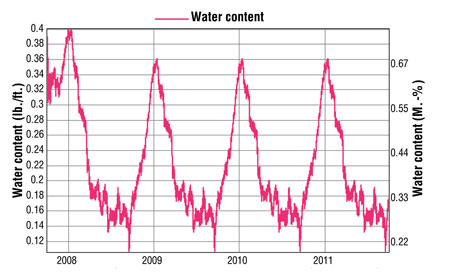
Figure 1: A WUFI output for the estimated water content in a gypsum roof board on a roof assembly in the San Francisco area
Taking, for example, the roof assembly previously discussed (TPO, gypsum roof board, polyisocyanurate insulation and plywood deck) on a building in the San Francisco area, Figure 1 shows the estimated water content in the gypsum roof board after three years. The figure shows that moisture drives toward the top of the board during winter and moves toward the bottom of the board during summer. But more important, the figure shows that each year there is a decrease in the total amount of water in the board. Figure 2 shows the estimated temperature and relative humidity of the gypsum board. Note that the relative humidity never is high enough to cause condensation to occur within the board.
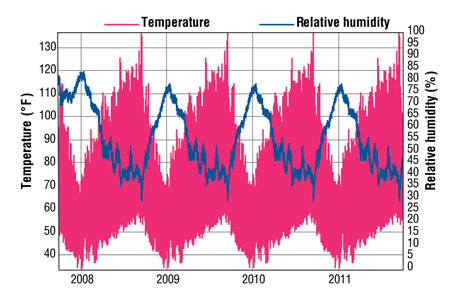
Figure 2: A WUFI output for the estimated temperature and relative humidity of a gypsum roof board on a roof assembly in the San Francisco area
Figures 3 and 4 are for the top layer of polyisocyanurate insulation. As with the gypsum board, the water content in the polyisocyanurate decreases over time, and the relative humidity is never high enough to cause condensation. The program output also produces similar graphs for the bottom layer of insulation and the plywood deck.
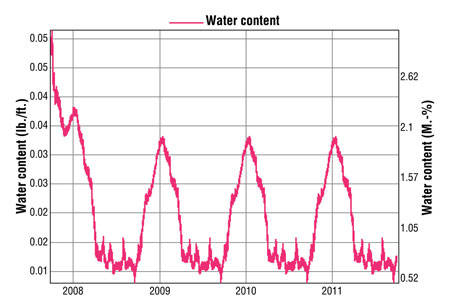
Figure 3: A WUFI output for the estimated water content in the top layer of insulation of a roof assembly in the San Francisco area
The program output does not say whether the results for a given assembly are OK. That decision is left to you. The only hard rule relates to moisture content. If moisture is accumulating within a proposed assembly each year, it is likely there eventually will be enough moisture within the assembly to cause serious performance problems.
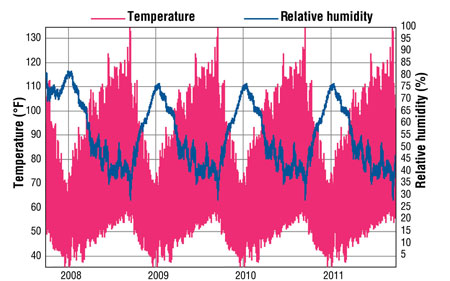
Figure 4: A WUFI output for the estimated temperature and relative humidity of the top layer of insulation of a roof assembly in the San Francisco area
However, even when a given assembly does not annually experience a net increase in moisture, that does not necessarily mean the assembly will perform well.
For example, if there is a spike in moisture content in one component that lasts for a few months, depending on a variety of conditions, that spike could adversely affect performance. But if the spike's relatively high moisture content lasts only a short time, the moisture excursions could have no influence on performance. Judging issues such as these rests with you, so your knowledge of and experience with various factors, such as the influence of degree of moisture content and exposure length on the specified materials, are important.
Why use it
What I find interesting and valuable is the insight WUFI can give (provided reasonable input values are used). Before WUFI, roof assembly designers could specify assemblies that had long track records of successful performances in similar climates. This can be an effective approach, but it precludes using materials or arranging them in ways that were not done many years ago. Once a roof assembly design goes outside the parameters of historical practice, it is in the realm of uncertainty.
I also find the use of what-if scenarios intriguing. For example, you can enter expected interior temperature conditions and make a run to see whether an assembly is OK. If it is, you can make a couple more runs at more severe temperature and humidity conditions. If the assembly is still OK, great. But if the later runs show problems, you can change the roof or wall assembly so it accommodates more severe interior conditions. (Who knows whether an HVAC system will be maintained to provide original design conditions?)
I particularly like using WUFI to determine whether there is a need for a vapor retarder. The previous methods used for assessing the need for a vapor retarder are based on rather simplified approaches, which generally are adequate but can lead to incorrect assessments in some cases.
Can it be believed?
I have a lot of confidence in the fundamental science upon which WUFI is based, and I have confidence in the computer program. The real issue I see is the validity of the material property data, particularly the moisture content of materials at the time of application.
As the catalog of material properties expands, part of my concern will be addressed. However, the issue of moisture content at the time of construction is one that will always exist.
Separate from the believability of the results is the question of interpreting them. I think more guidance needs to be developed to aid users in their assessments of outputs.
In addition, WUFI can assess an assembly with a vent cavity, such as a vented nailbase in a steep-slope roof assembly. However, there is limited guidance on the effective air flow through various cavities. This is another area where additional research and inclusion of data in the WUFI catalog would be helpful for users.
And like learning many new things, learning WUFI is not a quick or easy undertaking. ORNL offers a two-day training course, which I think is vital to take. After taking the course and working through a few sample problems, you likely will find the program easy to use. A four-day advanced course also is available. To date, about 600 people in North America have taken the two-day course, and about 50 have taken the four-day course.
Obviously, sufficient training is necessary to use WUFI, but I think success with the program lies in good judgment in entering data and interpreting results.
Now for the costs. They are not trivial (at least for a small firm): The two-day course costs about $900, and unless the course is offered in a city near you, there also will be travel expenses.
In addition to the training costs, there is a significant licensing fee to use the program, which ranges from about $3,000 to $12,000, depending on how many users you have. A free North American version can be downloaded, but there is a stipulation that the free version can only be used for research and education. Therefore, its use is precluded from project work. Also, the free version has some input limitations the commercial version does not have.
Learn a new trick
It takes effort and resources to become a WUFI user, but I strongly urge roof system designers to consider using this new tool. It has great potential to keep you from designing a roof assembly that is destined for failure. It also has potential use in failure analysis, but a great deal of care is needed when so used. It is one thing to use WUFI as a tool to evaluate various options when designing a new or reroofing project. It is quite another to use WUFI to assert that some party was negligent in its work.
Thomas L. Smith, AIA, RRC, is president of TLSmith Consulting Inc., Rockton, Ill.
Adding to the catalog
I encourage manufacturers associations to sponsor development of material property data for their materials if their materials are not already in the WUFI catalog. The catalog contains many wall materials but relatively few roofing materials. And some materials in the catalog need fine-tuning.
For example, polyisocyanurate roof insulation is in the catalog, but the data are only for the foam, not the facer. It would help to have the facer data also cataloged. Another example is the in-situ performance of vapor retarder materials that are perforated by fasteners. The catalog provides data for various vapor retarder materials, but the data do not account for those assemblies where fasteners penetrate a retarder. Without these data, users are required to make qualitative judgments without a lot of hard information.



COMMENTS
Be the first to comment. Please log in to leave a comment.