
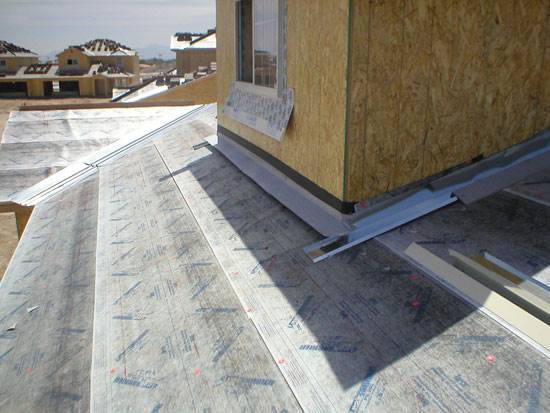
 Photo courtesy of Tarco, Little Rock, Ark.
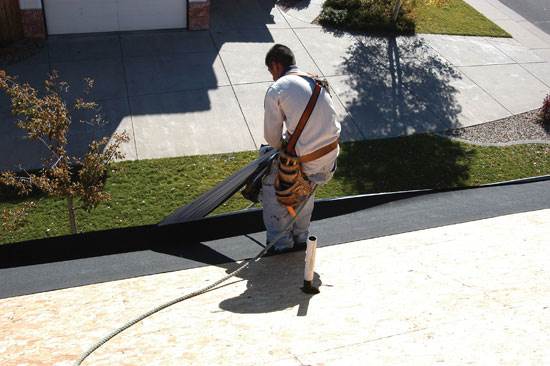 Photo courtesy of Tarco, Little Rock, Ark.
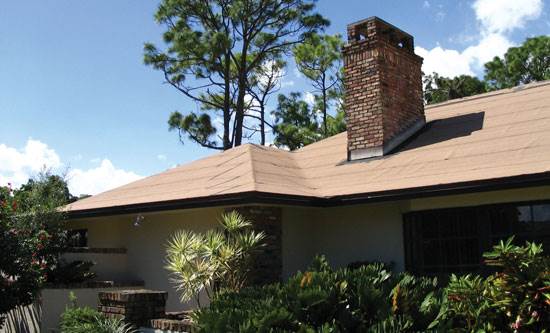 Photo courtesy of Tarco, Little Rock, Ark.
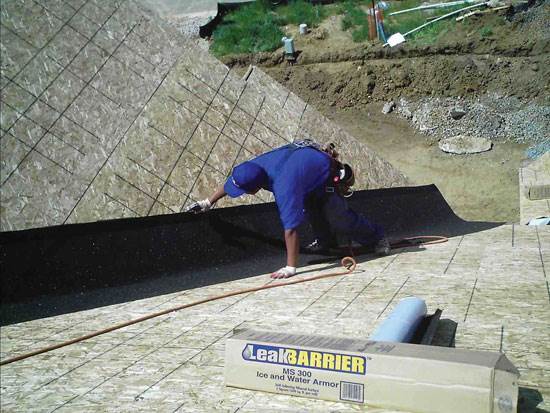 Photo courtesy of Tarco, Little Rock, Ark.
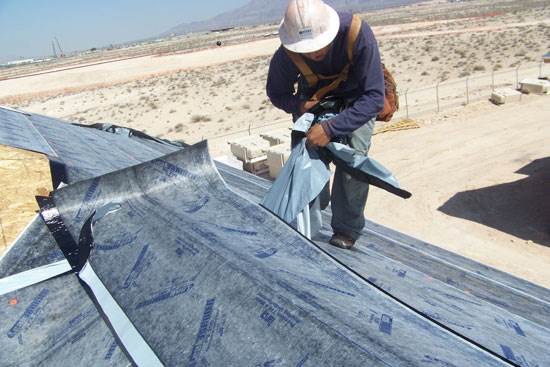 Photo courtesy of Tarco, Little Rock, Ark.


Reeling from more than a decade of powerful hurricanes dating to the devastation caused by Hurricane Andrew in 1992, Florida enacted the nation's toughest building rules in 2007. Among them was a requirement that self-adhering underlayment be installed with all new and replacement steep-slope roof systems.
Some of those rules were revised in 2008, including a rule that makes self-adhering underlayment optional rather than mandatory. As could be expected, there was an initial surge in demand for self-adhering underlayment following the initial rule's passage, but what is surprising is the continued strong demand after the rule was modified.
Specifically, Section 201.2 of Rule 9B-3.0475 (Hurricane Mitigation Retrofits For Existing Site-Built Single Family Residential Structures) describes options for a "roof secondary water barrier for site-built single family residential structures."
Adopted by the Florida Building Commission in October 2007, the rule was quite stringent, mandating that roofing contractors either cover all joints with a minimum 4-inch-wide strip of self-adhering polymer-modified bitumen tape applied directly to sheathing or decks or cover entire roof decks with approved self-adhering polymer-modified bitumen cap sheets. The rule was relaxed in March 2008 to allow other options, including covering the entire roof deck with "an approved asphalt impregnated 30# felt underlayment installed with nails and tin-tabs as required for the HVHZ" with no additional underlayment required.
Clearly, some market research was needed to determine why roofing contractors are voluntarily using self-adhering underlayment on many projects. Tarco, Little Rock, Ark., commissioned Kellen Co., New York, to interview roofing contractors and roof consultants throughout Florida about their initial responses to the earlier rule and how and why they still are using self-adhering underlayment.
Contractor reaction
Mark Landis, president of Florida Roofing of Palm Beach County, West Palm Beach, is familiar with Florida's hurricane mitigation rule.
"Initially, it was costly and restrictive," he explains. "After the Florida legislature passed it in October 2007, the Florida Roofing, Sheet Metal and Air Conditioning Contractors Association sought to expand the acceptable options. Eventually, the rule was amended to include several underlayment options, including self-adhering membranes."
He says the modified rule affected contractors in two ways. Some did not know how to install self-adhering underlayment and went back to their previous methods as soon as the requirements were relaxed. Others decided using self-adhering underlayment made sense and continued to use it. In other words, some contractors stuck with self-adhering underlayment while some switched to asphalt-saturated felts.
"Before the October 2007 legislation, I estimate 10 to 20 percent of contractors were using self-adhering underlayment. Currently, that figure is more like 50 percent," Landis says.
Mike King, president of Pinnacle Services, Pinellas, Fla., says it didn't take long for most contractors in his area to switch to self-adhering underlayment.
"Once you put self-adhering underlayment beneath shingles, you're watertight," he explains. "It quickly became clear that sealing the sheathing joints with tape and then covering them with saturated felt was not efficient. It's much simpler to cover a whole deck with self-adhering underlayment."
Steep-slope roof systems shed water. Asphalt-saturated felts have poor exposure limits, and problems can result when they are left exposed in the rain even for short time periods. A typical self-adhering underlayment has a much longer exposure limit (30 to 120 days) depending on the specific product and local building codes. Some even have an unlimited exposure rating. It is a good idea to check with manufacturers about exposure limits for specific products and verify product recommendations are approved by state and local building codes.
According to King, the use of self-adhering underlayment increases material costs only marginally, but labor costs are a different story.
"A lot of precautions are necessary when using saturated felt," he says. "Previously, we would watch the weather carefully after we installed felt underlayment. With self-adhering underlayment, once it is down, that's it. I sleep a lot better at night.
"On new construction, builders or general contractors are quick to approve self-adhering underlayment when they understand the short-term benefits of the dry-in and long-term benefits for homeowners," he continues. "For reroofing projects, homeowners are willing to pay a little extra once I explain the advantages of a secondary water barrier. Because labor costs are the same, the cost increase is only a few percent and the homeowner gets a much better roof. It's an easy sell."
It should be noted that when self-adhering underlayment is installed over an entire roof area, it acts as an air retarder and vapor retarder. When a vapor retarder is installed over an entire steep-slope roof deck, ventilation, moisture control and proper vapor retarder placement (relative to the insulation) must be considered to avoid potential problems.
Depending on a building's structure, insulation and location, complex calculations may be required to properly design a roof system so moisture accumulation is prevented. The design requirements may be different for, say, a building in San Francisco compared with one in Chicago or Miami. It is important to check applicable local building codes relating to the use of vapor barriers and ventilation. A discussion of suitable designs for various climates can be found in The NRCA Roofing and Waterproofing Manual, Fifth Edition.
Consequential damages
The experience in Florida has implications for the use of secondary water barriers on a national and international scale. Although most of the U.S. is not at high risk for hurricane damage, severe storms and other weather events that damage primary roof coverings also result in consequential damage, so a secondary water barrier can be a good idea for any building.
NRCA and the International Code Council recommend the use of a secondary water barrier for all steep-slope roof systems. Self-adhering polymer-modified bitumen underlayments provide a weatherproofing layer beneath primary roof coverings, and asphalt-saturated felts are water-shedding.
With asphalt-saturated felt, standing water can work its way under the felt in severe weather or in vulnerable areas of the roof and water can seep through fastener holes or other defects; self-adhering underlayment contains a compound that seals around fasteners.
Jim Freedman, president of A.L. Freedman Co., Fort Myers, Fla., previously worked for many years as a roofing contractor in Massachusetts and for four roofing product manufacturers. He says that though self-adhering underlayment has a long history in the North where it protects against ice dams, he believes the same logic applies in the South: Interior structural damage caused by water intrusion under a primary roof covering—whether caused by ice buildup, water pooling or windblown rain—can be prevented with a secondary water barrier.
"Shingles, tile and metal roofing are water-shedding but not waterproof," Freedman explains. "When a hurricane or severe weather blows off roofing materials or blows water underneath a roof, the typical asphalt-saturated felt underlayment does not protect a building's interior.
"When Hurricane Charley hit in 2004, we looked at many roof system failures," he continues. "The advantage of self-adhering underlayment was obvious: It adheres well to decks and seals around nail holes. Saturated felt nailed to decks either blew off or, once exposed, could not prevent the massive water entry we saw after the hurricane. In some cases, the water damage was catastrophic."
The same situation occurs in the Northeast and Midwest when ice dams allow water under shingles near eaves and valleys.
In Florida, one option allowed by the hurricane mitigation rule was to cover plywood roof decks' joints with self-adhering tape. Contractors eventually discovered it was just as easy to install self-adhering underlayment over entire roofs.
Direct to deck
Joe Byrne, a roofing industry consultant and owner of Byrne Roofing in West Palm Beach, says some jurisdictions require asphalt-saturated felt to be installed on decks with a second layer of self-adhering underlayment over them. However, he prefers self-adhering underlayment to be installed directly to decks and specifies it that way wherever possible.
According to Byrne, when self-adhering underlayment is installed directly to a deck, it will not blow off unless the entire deck blows off. Both versions of Florida's hurricane mitigation rule allow for the practice of installing self-adhering underlayment on top of a traditional felt. This practice is favored by some local codes because both underlayment layers easily can be torn off when reroofing. When the self-adhering underlayment is attached directly to a roof deck, it is not practical to remove the underlayment for reroofing. Depending on the primary roof system's expected service life, the benefits of a fully adhered direct-to-deck application should be weighed against possible future reroofing requirements.
Another reason to use self-adhering underlayment, Byrne says, is it allows for a more complete dry-in.
"Dry-in with an asphalt-saturated felt is not really a dry-in because it does not provide a water barrier," he explains. "With a self-adhering underlayment, you can leave it exposed for 30 to 120 days and you have some ultraviolet [UV] protection."
This protection was crucial when Florida experienced shingle and tile shortages, Byrne notes, saying the same benefits can apply in other U.S. regions.
"When a storm hits, many houses require attention at once," he says. "If you can install self-adhering underlayment, it's easier to schedule the installation of new shingles. When asphalt-saturated felt is used, the UV light draws the oils right out of it and the underlayment already is deteriorating before shingle installation begins."
The future
In the past, self-adhering underlayment was used to provide extra protection for vulnerable sections of roofs, especially in climates where ice damming occurs. The experience in Florida suggests the complete coverage of steep-slope roofs with self-adhering underlayment offers many advantages.
Presently, complete coverage with self-adhering underlayment is an option typically installed at a roofing contractor's discretion in consultation with a homeowner. The advantages are that it simplifies installation; gives homeowners longer-lasting roofs; and can reduce the risk of consequential damage for insurers. Caveats are that it acts as a vapor retarder and adheres permanently when attached directly to decks.
Florida contractors report the switch has been positive. Whether contractors in the rest of the U.S. will follow Florida's example remains to be seen.
Steve A. Ratcliff is president and chief executive officer of Tarco, Little Rock, Ark.


COMMENTS
Be the first to comment. Please log in to leave a comment.