
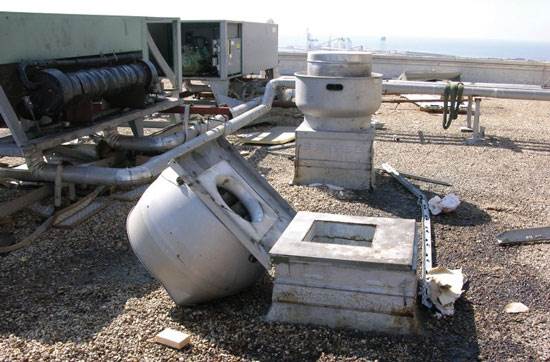
 Photo courtesy of TLSmith Consulting Inc., Rockton, Ill.
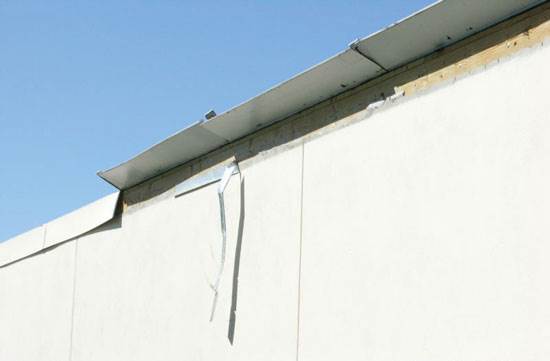 Photo courtesy of TLSmith Consulting Inc., Rockton, Ill.
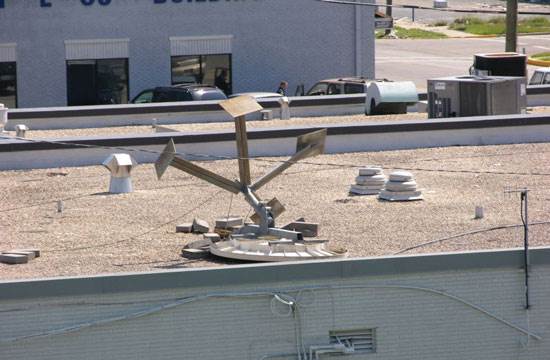 Photo courtesy of TLSmith Consulting Inc., Rockton, Ill.
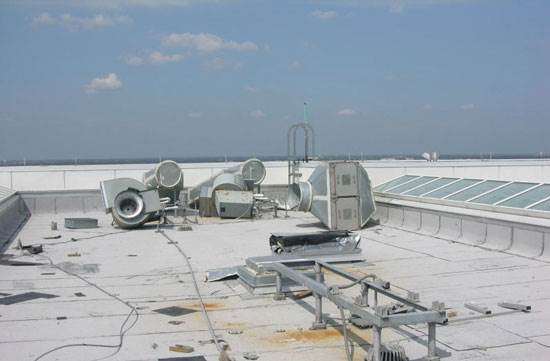 Photo courtesy of TLSmith Consulting Inc., Rockton, Ill.


Editor's note: The following article is adapted with permission from the American Society of Civil Engineers (ASCE) from a peer-reviewed paper, "Wind Vulnerability Assessment of Roof Systems and Rooftop Equipment for Critical Facilities: A Preliminary Protocol for Design Professionals," presented at ASCE's April 2011 Structures Congress.
Roof systems and rooftop equipment are key building components that frequently are damaged during high winds. These components' wind vulnerability depends on various factors, including adequacy of their design and installation and material degradation over time. Leakage from damaged roofs or rooftop equipment has interrupted numerous facility operations, and many critical facilities, such as emergency operations centers, fire and police stations, hospitals, nursing homes, power plants, schools and other buildings that are essential for delivering vital services or protecting a community, have been forced to evacuate occupants because of roof leakage.
By identifying wind vulnerabilities, mitigation efforts can be undertaken to avoid future damage and disruption of services provided by critical facilities. Design professionals can use the following preliminary protocol to systematically guide their assessments of roof systems and rooftop equipment.
FEMA P-424, "Design Guide for Improving School Safety in Earthquakes, Floods, and High Winds"; FEMA P-543, "Design Guide for Improving Critical Facility Safety from Flooding and High Winds"; and FEMA P-577, "Design Guide for Improving Hospital Safety in Earthquakes, Floods, and High Winds" recommend performing a vulnerability assessment on all critical facilities older than five years. If a facility is located in a hurricane-prone region (as defined in ASCE 7-10, "Minimum Design Loads for Buildings and Other Structures"), the assessment is recommended regardless of building age. These publications note it is particularly important to perform assessments on facilities located in hurricane- and tornado-prone regions.
Preliminary protocol
Accurately assessing the wind resistance of existing roof systems and rooftop equipment is difficult in part because of a lack of a comprehensive protocol and severe lack of field test methods. Accordingly, good professional judgment is vital for a quality assessment. The design professional performing the assessment should be experienced with the type of roof system on the building being evaluated.
As a starting point for the assessment, a discussion should be held with the building owner to determine his or her expectations regarding desired building performance.
The following preliminary protocol identifies two levels of assessment. For some buildings, a Level 1 assessment will be sufficient. For other buildings, Level 1 and Level 2 assessments should be performed.
A Level 1 assessment consists of reviewing the roof system's historical file (as-built drawings and specifications, submittals, previous leakage and repair reports); discussion with building owner personnel who are familiar with the roof to determine whether it is leaking and to obtain historical information that is not in the file; performing a field investigation; and providing a report.
A Level 1 assessment should address the general condition (remaining service life) of the roof and rooftop equipment. If the Level 1 assessment reveals the roof is at or near the end of its useful service life, it should be scheduled for reroofing. See FEMA P-424, P-543 and P-577 for reroofing recommendations.
A Level 1 assessment also should address wind resistance, which I will discuss shortly.
If a Level 1 assessment reveals the roof has several more years of useful service life, a Level 2 assessment is recommended for buildings located where the basic wind speed is greater than 120 mph based on ASCE 7-10. However, many building owners will be unable to afford a Level 2 assessment because of budgetary constraints and the necessary destructive investigations.
Although all critical facilities are valuable assets, some are more critical than others. A hospital, for example, is considered a more valuable asset than a clinic. For the most important critical facilities, funding a Level 2 assessment is prudent because it will provide a more accurate vulnerability assessment.
A Level 2 assessment consists of performing field-uplift testing (for those systems where a test method exists), performing destructive observations and providing a report. For those systems that have insulation below the roof covering, a nondestructive evaluation to check for moisture also is recommended.
A Level 2 assessment's purpose is to validate wind-resistance information provided by the as-built drawings, specifications and submittals or to obtain wind-resistance information when documents are unavailable.
Level 1 assessment
"Wind Vulnerability Assessment of Roof Systems and Rooftop Equipment for Critical Facilities: A Preliminary Protocol for Design Professionals" recommends the following steps as part of a Level 1 assessment.
General field assessment
As part of the field investigation, visually observe the roof for signs of distress and detachment, such as tented fasteners and large blisters. Walk the entire perimeter of the roof (make two trips if the width of the perimeter zone exceeds 8 feet). Also walk the field of the roof at intervals not exceeding 20 feet. With each footfall, be sensitive to a change in substrate softness, which could indicate wet insulation or displaced materials. Also, be sensitive to indications of lack of attachment of adhered roof membranes and insulation boards.
Nailers and equipment curbs
Check the drawings and specifications to determine whether attachment criteria were given for nailers that occur below edge flashings and copings and for rooftop equipment curbs and stands. If so, determine whether the specified attachment is sufficient to resist current uplift loads (and overturning loads for curbs and stands) using a safety factor of 3.
Edge flashings and copings
For shop-fabricated units, check whether the vertical flange is cleated. (For copings, check both vertical flanges.) If the vertical flange is face-fastened, check the fastener type and spacing. If the flange is not adequately face-fastened or it is not cleated, the edge flashing or coping is susceptible to blow-off.
Also, grab the bottom of the vertical flange with both hands and try to rotate the flange. (Appropriate safety precautions should be taken when performing rotation tests.) For copings, try to rotate the inner and outer flanges. Perform this rotation test at corners and a few locations along the perimeter.
Weak edge flashings and copings easily will be detected by an experienced investigator. However, an edge flashing or coping may resist rotation and give the impression that it possesses adequate wind resistance when it actually does not. A field test method (other than hand manipulation) to provide a more definitive evaluation of resistance does not currently exist.
Gutters
Visually inspect gutters to see whether there is a mechanical connection or interlock between the gutters and gutter brackets. If gutters are not connected or are inadequately connected to the brackets, the gutters are susceptible to blow-off.
Additionally, perform rotation tests as described. For some tests, place a hand on either side of a bracket. For other tests, place both hands midway between two brackets. A field test method (other than hand manipulation) to provide a more definitive evaluation of resistance does not currently exist.
Also evaluate gutter load path. The uplift and rotational wind load exerted on the gutters will be transferred to the wall, nailers or deck depending on the bracket design and attachment. A safety factor of 3 is recommended for gutters.
Parapet base flashings
For fully adhered base flashings, visually check for detachment. Also, check for detachment by spot-slapping with the palm of your hand. For mechanically attached base flashings, spot check fastener locations using one of the techniques described in "Wind Vulnerability Assessment of Roof Systems and Rooftop Equipment for Critical Facilities: A Preliminary Protocol for Design Professionals" for locating mechanically attached single-ply membrane fasteners.
Also, if the base flashing is mechanically attached but the membrane is fully adhered at the roof, ballooning of the base flashing has high potential to cause lifting and peeling of the roof membrane. Check whether the base flashing is applied directly to brick. If so, the base flashing likely is inadequately attached because of the surface irregularity (lack of planar flatness) that often is associated with the roof-side of brick parapets.
Regardless of base flashing type or attachment method, when performing checks, check corner areas and a few locations along the perimeter.
Ballasted single-plies
If the building is not in a hurricane-prone region and has a single-ply membrane that is ballasted with aggregate, pavers or cementitious-coated insulation boards, check whether the system (including parapet height) complies with ANSI/SPRI RP-4, "Wind Design Standard for Ballasted Single-ply Roofing Systems."
If the building is located in a hurricane-prone region and has aggregate surfacing, lightweight pavers (those weighing less than 22 pounds per square foot [psf]) or cementitious-coated insulation boards, FEMA P-424, P-543 and P-577 recommend roof system replacement.
Wind-borne debris
If the building is located in a hurricane-prone region, check whether the roof system includes a secondary membrane that will avoid water leakage into the building in the event the roof membrane is punctured by wind-borne debris.
If as-built drawings or submittals are not available, a test cut should be taken to determine roof system composition. If the roof consists of spray polyurethane foam of the thickness recommended in FEMA P-424, P-543 and P-577 or the roof is surfaced with concrete pavers weighing a minimum of 22 psf, the foam or pavers should provide adequate protection.
Drainage
If the building is located in a hurricane-prone region and has primary through-wall scuppers or roof drains, evaluate the potential for the scuppers or drains to become blocked by leaves, tree limbs and other wind-borne debris. See FEMA P-424 for guidance. Verify that secondary drainage is provided for all roof areas that have parapets or edge flashings on raised curbs.
Rooftop equipment
For fans, HVAC units, relief air hoods and condensers, check the equipment's attachment to the curb or stand. FEMA P-424, P-543 and P-577 provide attachment guidance. Do not assume the equipment's dead load is sufficient to resist the wind load. If wind resistance only is provided by the equipment's dead load, perform wind uplift and overturning load and resistance calculations to determine whether the dead load is sufficient to resist the current wind load.
As a qualitative evaluation, push and lift the equipment. Equipment with weak or no attachment may be detected by an experienced investigator. However, equipment may resist movement and give the impression that it possesses adequate wind resistance when it actually does not.
For fan cowlings, if the basic wind speed is greater than 120 mph, check whether the manufacturer specifically engineered the cowling attachment to resist the current design wind load or whether the cowling has strap or cable tie-downs.
For exposed ductwork, evaluate the ducts' wind resistance and check whether the ductwork is mechanically attached to supports that are anchored to the roof deck.
Also, as a qualitative evaluation, push and lift the ductwork. Ductwork with weak or no attachment may be detected by an experienced investigator. However, ductwork equipment may resist movement and give the impression that it possesses adequate wind resistance when it actually does not.
If vibration isolators are used to support equipment, check whether the isolators provide uplift resistance or whether cables or straps are present to provide wind resistance.
Check adequacy and tautness of guy-wires on boiler and exhaust stacks. If guy-wires do not exist, check the stack's wind resistance.
For equipment access panels and doors, check attachment adequacy. See FEMA P-424, P-543 and P-577 for guidance.
For sheet-metal hoods on HVAC units, check attachment adequacy. See FEMA P-424 for guidance.
If the basic wind speed is greater than 120 mph, check attachment adequacy of natural gas and condensate drain lines. See FEMA P-424 for guidance.
If screens occur around equipment, check attachment adequacy.
Check attachment adequacy of satellite dishes. If wind resistance is provided by ballast (such as concrete masonry units or concrete pavers), perform calculations to verify the ballast is sufficient. In hurricane-prone regions, FEMA P-424, P-543 and P-577 recommend dishes be mechanically anchored rather than ballasted to a roof.
For lightning protection systems, spot check conductor connectors to verify the prongs engage the conductor, the connectors still are anchored and the connectors are about 3 feet on center. Also, spot check the air terminals to verify they are anchored. If the roof is more that 100 feet above grade or the building is in a hurricane-prone region where the basic wind speed is 135 mph or greater, special attachment is recommended. See FEMA P-424, P-543 and P-577 for guidance.
Level 2 assessment
For a Level 2 assessment, observations of nailers is recommended to determine attachment quality.
To verify or determine the attachment of nailers that occur below edge flashings or copings, remove lengths of edge flashing or coping (which typically are 8 or 10 feet long) and membrane material so the nailer fasteners can be observed. Remove at least two fasteners per length of edge flashing or coping to determine fastener type and length (embedment). It is recommended that one length of edge flashing or coping be removed at corner areas and at a few locations along the perimeter.
Data analysis and reporting
After reviewing the roof's historical file and performing calculations and field investigation(s), the collected data must be analyzed in the context of the building owner's expectation regarding desired building performance. Although unlikely, the analysis may reveal no remedial work is required to meet the desired building performance. The analysis may reveal the need for relatively minor enhancements, or it may reveal the need to reroof. With all three scenarios, there may be acceptable residual risk that the building owner considers too expensive to correct.
When reporting the Level 1 and 2 findings and analysis to the building owner, it is important to discuss limitations of the roof's wind vulnerability. As previously noted, a Level 2 investigation will provide a more accurate assessment. However, even with a comprehensive Level 2 investigation, the true vulnerability of the roof and rooftop equipment will not be known until tested by a real wind event.
The assessment limitations are due, in part, to the severe lack of field test methods and the fact that field testing and various field checks are performed at discrete locations. These tests and checks provide data for conditions and wind resistance in areas that were tested or checked. However, there always is the potential for an undetected anomaly that can lead to water infiltration. Accordingly, it is prudent for critical facility owners to have contingency plans in the event roof leakage occurs.
For example, if roof leakage begins to occur at a given location in a hospital, a pre-event plan should be available to the staff in that area that directs where their department should be relocated within the facility. A pre-event plan also should be available for evacuating the entire facility.
If the vulnerability assessment reveals the need to reroof or strengthen attachment of rooftop equipment, see FEMA P-424, P-543 and P-577 for guidance.
Conclusions
"Wind Vulnerability Assessment of Roof Systems and Rooftop Equipment for Critical Facilities: A Preliminary Protocol for Design Professionals" needs to be expanded to address special considerations and guidance pertaining to a variety of systems, such as asphalt shingles, metal panels, slate, tile, vegetative roofs and photovoltaic panels. Additional specificity also is needed regarding the number of tests and field checks to be taken, and additional specificity is needed for various types of field checking.
Also, mitigation efforts can be ineffective if they do not address all items that are likely to fail. To help ensure all significant vulnerabilities with respect to wind, wind-borne debris and wind-driven rain are identified, an assessment should include the structural system and entire building envelope.
For facilities located in hurricane-prone regions, ramifications of interruption of municipal utilities also should be evaluated. FEMA P-424, P-543 and P-577 provide a general checklist for performing assessments and examples of common vulnerabilities.
Two other papers presented at the Structures Congress, "Wind Risk Assessments for Cladding and Glazing Systems in Critical Facilities" by P.E. Beers and "Vulnerability Assessments of Structural Frames for Critical Facilities" by W.L. Coulbourne, provide guidance on vulnerability assessments of structural and glazing systems. However, even with these other resources, there is a need for a comprehensive guide for vulnerability assessment. The Federal Emergency Management Agency (FEMA) is considering developing such a guide.
To obtain a copy of "Wind Vulnerability Assessment of Roof Systems and Rooftop Equipment for Critical Facilities: A Preliminary Protocol for Design Professionals," which was developed with FEMA's financial support, go to ascelibrary.org.
Thomas L. Smith, AIA, RRC, is president of TLSmith Consulting Inc., Rockton, Ill.


COMMENTS
Be the first to comment. Please log in to leave a comment.