
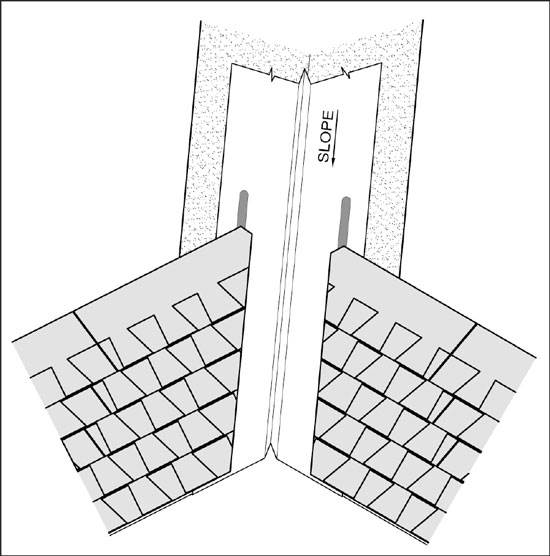
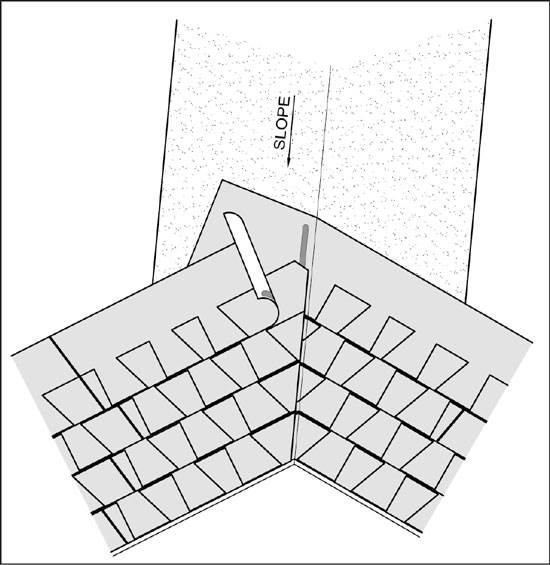
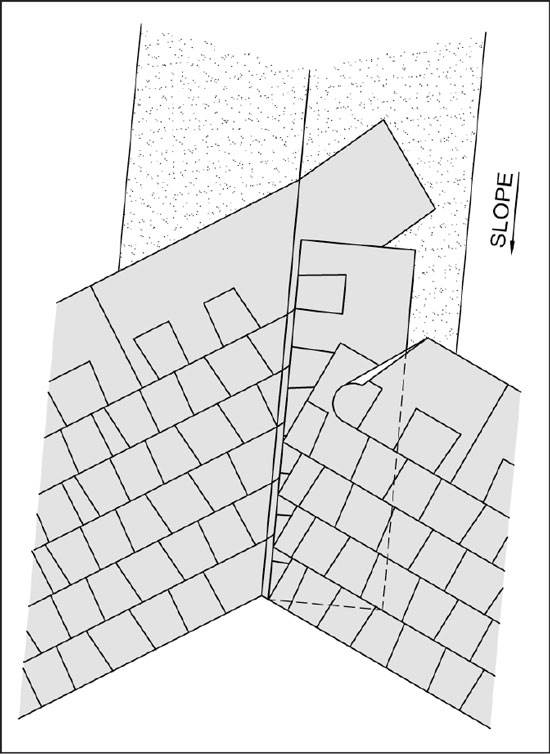


Valleys are created when two sloping roof areas intersect and are one of the critical detail points on a steep-slope roof system. They occur on primary roof areas and where projections, such as dormers, break the plane of the main roof. A valley's main function is to create runoff pathways to direct water flow from the roof planes into a valley trough. The volume of water varies with the valley's length and slope.
Because of their configurations, valleys are susceptible to debris accumulation from vegetation, foliage and windborne particulates. Valley function and service life are affected by climatic conditions such as snow, ice, rainfall frequency and intensity, humidity, temperature extremes and wind. Geographic factors influencing valley function and service life include building location, elevation and oriented exposure to solar load intensity.
All these issues determine which valley configuration is appropriate for the specific building and selected roof system; I will discuss valley configuration as it relates to asphalt shingles.
The three basic valley types for asphalt shingle roof systems are woven, open and closed-cut. In addition, there are recognized options for open and closed-cut valleys commonly referred to as "California open valleys" and "California closed-cut valleys."
Underlayment
Underlayment is an integral part of valleys and provides a waterproof base. All valley installations require appropriate underlayment layers and valley lining. Underlayment layers in a valley can range from a minimum code-compliant asphalt-saturated No. 15 or No. 30 felt to heavy-weight rolled roofing and polymer-modified bitumen ply sheet or ice-dam protection membrane.
Underlayment layers should be at least 36 inches wide. NRCA recommends using a full-width sheet of polymer-modified bitumen underlayment, base sheet or self-adhering polymer-modified bitumen sheet.
Valley underlayment sheets should be centered in a valley and secured with only enough fasteners to hold them in place until the primary valley installation is complete. Self-adhering sheets may not require fastening. Underlayment material from the two adjacent roof planes should overlap the valley base ply by at least 6 inches. The valley sheets should be tucked tight and lapped with no bridging, and all fasteners should be kept a minimum of 8 inches from the valley's center line.
Valleys with less than a 4:12 (18-degree) slope in freeze-thaw or heavy rainfall regions may require holding fasteners back more than 8 inches or covering nail heads with roof cement or self-adhering polymer-modified bitumen target patches.
Woven valleys
Woven valleys are constructed by interlacing the rows of shingles from intersecting roof planes. This system is acceptable with three-tab and low-profile architectural shingles and valley slopes greater than 4:12 (18 degrees). Because woven valleys are more prone to debris accumulation, snow and ice buildup, and material bridging, NRCA does not recommend using them.
Open valleys
Open valleys are constructed by installing a metal lining over the valley underlayment using corrosion-resistant metal. The underlayment should be a minimum 36-inch-wide polymer-modified bitumen sheet, base sheet or self-adhering underlayment. The rows of shingles from adjacent roof planes are held back from the center line creating a clear, unobstructed channel for runoff.
NRCA recommends valley metal be formed with a center line rib at least 1 inch high and 24 inches wide and installed in lengths no longer than 10 feet to control thermal movement. Valley metal can be installed with fastened cut flanges or hemmed edges secured with clips.
Open valleys are recommended for high-profile architectural asphalt shingles and shingle systems that include valleys with a 4:12 (18-degree) slope or less. Low-slope areas that accumulate debris from foliage and vegetation and climate zones that experience frequent freeze-thaw cycling are conditions that deserve consideration for open-valley enhancement. Options for enhancing open-valley construction include using a clipped flange securement; stripping in the metal flanges with a 9- to 12-inch strip of self-adhering polymer-modified bitumen underlayment material; adding a closure at the eave where the center rib terminates; and tapering the shingle cut from the top edge to low end.
Closed-cut valleys
For closed-cut valleys, shingles on one roof plane are installed through a valley and extended at least 12 inches into the intersecting plane. Shingles from the other side are run through the valley center line and cut along a line parallel to and 2 inches from the center line. Each end shingle strip should have the upper corner trimmed and set in a bead of roof cement.
NRCA recommends shingles first be installed on the valley side with the lowest slope or shortest distance to the ridge. If all conditions are equal, either side may be installed first. To avoid nail placement too close to the center line (6 inches or less) it may be necessary to cut a strip short and extend a full strip through the valley.
California valleys
The closed-cut, or open, California valley is a distinctive style option for asphalt shingle valley construction. The underlayment, sheet-metal liner (if required) and initial shingle covering into or through the valley follow the same guidelines for the standard closed-cut valley and open-valley construction: For a closed-cut valley, the installer should snap a chalk line 2 inches from the center line on the cut side; for an open valley, the installer should snap two chalk lines defining the cut edges of the valley on either side of the center line.
For a closed-cut California valley, a vertical run of strip shingles is installed along the chalk line end-to-end with the butt edge toward the valley. The shingles on the cut edge plane are positioned by setting the lower tip of the first shingle in each row on the leading edge of the vertically installed shingle. On the open California valley, this procedure is repeated on each side of the center line. At this point, the installation procedures for both types of California-style valleys take different paths.
The offset dimension created by aligning the lower tip of each successive shingle row with the valley line decreases as a roof plane's slope increases. Most architectural asphalt shingles have a specified offset distance designated by the manufacturer. If the offset distance is specified, the dimension may not be achieved unless the first shingle in each row is trimmed. Therefore, it is absolutely necessary to follow a manufacturer's installation instructions if California-style valleys are acceptable.
California-style valleys are not recommended for valley slopes less than 4:12 (18 degrees). Snow accumulation, frequent intense rainfall incidents and excessive debris accumulation should be considered when deciding to use California-style valleys; these reasons and the aesthetics of the California-style valley should be explained to consumers.
Critical points to remember
Valley underlayment and flashing combined with valley construction comprise one of the most critical details of an asphalt shingle roof system. Key points in all valley details are the upslope end where it terminates (ridge, dormer crest and unequal rafter lengths) and the down-slope end (eave, dormer to interface and intersection with side wall). Selection of valley type is determined by material type, roof plane slope, climate and aesthetic expectations.
Upgrading valley underlayments in line with the expected service life of roof covering materials, number of layers and width of system components should help provide a watertight seal necessary at valley locations.
Tom Bollnow is an NRCA senior director of technical services.


COMMENTS
Be the first to comment. Please log in to leave a comment.