
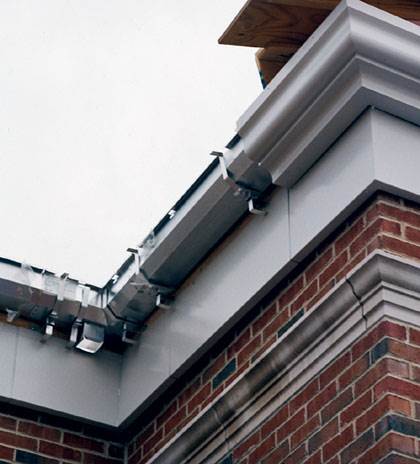
 Photo courtesy of Geudtner & Melichar Architects, Lake Forest, Ill.
Picture this: As part of a reroofing project for an old home, you replace some gutters. During the removal process, some lead-based paint from the house flakes off and lands on the ground. Later that day, the homeowner's child is playing in the yard and puts some paint chips in his mouth, ingesting lead. The child ends up suffering from permanent disabilities.
Sound far-fetched? Maybe. But the U.S. Environmental Protection Agency (EPA) wants to ensure such scenarios never occur. As part of the Toxic Substances Control Act, EPA requires those who engage in renovation work—including roofing contractors—to provide a lead hazard information pamphlet to owners and occupants before beginning work or face fines up to $25,000 per day. Although EPA's pamphlet requirement dates to 1999, you may be unaware of it—a consultant recently reminded an NRCA member about the pamphlet.
EPA has several rules regarding distribution of the hazard pamphlet. First, pamphlets must be distributed to occupants and owners of single-unit and multiunit residential buildings built before 1978. Housing for elderly or disabled people is exempt unless a child younger than 6 years old lives in such a residence.
The pamphlet must be mailed at least seven days before work begins; it can be hand-delivered any time before work begins. However, work must begin within 60 days of pamphlet delivery. For buildings with four units or less, if you deliver pamphlets in person, you must obtain signed and dated acknowledgements of delivery. If you mail pamphlets, you must obtain proof of mailing from the post office. For buildings with more than four units, you must give the pamphlet to the building owner (and obtain receipt acknowledgement) and provide occupants of individual units with written notification of the scope and time frame of work, as well as a statement that lead-based paint may be disturbed. In addition, occupants must be made aware of the pamphlet and able to request one from you. All pamphlet receipt acknowledgements and building certifications must be retained for three years following a project's completion.
Emergency renovations and work limited to 2 square feet (0.19 m²) or less are exempt from the rules. In addition, if a building has been inspected by a certified inspector and deemed free of lead-based paint, it, too, is exempt from EPA's rules.
NRCA is in the process of issuing a Special Report about this topic; the report will be mailed to all NRCA members and posted on NRCA's Web site, www.nrca.net. For more information about or to obtain EPA's pamphlet, call the National Lead Information Clearinghouse at (800) 424-5323 or Harry Dietz, NRCA's director of risk management, at (800) 323-9545, Ext. 7505, or access bookstore.gpo.gov.
Ambika Puniani is editor of Professional Roofing magazine and NRCA's director of communications.


COMMENTS
Be the first to comment. Please log in to leave a comment.