
It is common knowledge that mold is everywhere. Fungi, which include mold and mildew, make up more than one-quarter of all life on earth, and some molds contribute significantly to our quality of life.
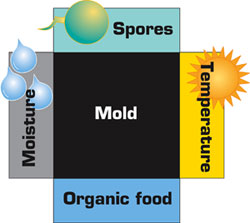
Mold needs these four key factors to grow. Moisture and organic food are the easiest to manage in buildings.
Recently, there has been increasing interest in the potentially damaging health effects a small number of mold species can have. These effects raise concerns for those involved in the roofing industry because mold increasingly has been found in commercial roof assemblies and can affect indoor air quality. In many cases, the ceiling plenum, which is in contact with a roof assembly, becomes the return air duct for a building.
Occupied buildings with interior moisture sources, such as recreation centers, paper manufacturing and food-processing plants, multifamily buildings and schools, can generate water vapor, which must dissipate or be ventilated so it does not accumulate and become a mold source.
These concerns are causing building owners, consultants and roofing contractors to consider roof assembly designs that can help restrict the growth of harmful mold and mildew. When designing commercial roof systems, there are design considerations, means and methods, such as water vapor management and the use of inorganic materials, that can help minimize mold and mildew.
The varying climatic regions in the United States have different mold exposure issues. A cold climate location and warm, humid location have vapor drives in opposing directions, but condensation still may occur within a roof assembly in both locations though in different areas. Even in a hot, arid climate, condensation may occur toward the cool, air-conditioned interior if vapor becomes trapped behind vinyl wall and/or ceiling treatments. Proper design becomes critical.
Why now?
There is a reason why mold has become a problem in the United States in recent years—the U.S. building industry is constructing buildings differently than a decade ago. Buildings are more efficiently constructed with energy conservation in mind, and technology has advanced to provide more effectively sealed construction that reduces the energy used to heat or cool buildings.
But as more care is being taken to conserve energy, a new problem is created. The less-stringent construction practices of the past allowed more movement of air through building envelopes, and that air movement allowed buildings to expel moisture and dry out. Because buildings are being constructed better with better materials, buildings are being tightened to the point where the free dissipation of moist air is being blocked and moisture is being retained. That can create mold problems.
Mold growth
Scientists say mold needs four key factors to grow: mold spores, the right temperature range, moisture and organic food. (See the figure.)
If any factor is missing, mold growth is inhibited. But not all the factors can be controlled. Mold spores always are present in indoor and outdoor air, and molds can flourish in any ambient temperature from 40 F to 100 F (4 C to 38 C).
However, the moisture mold needs can be somewhat controlled, and the use of inorganic materials in roof assemblies to deprive mold spores of food also can be controlled. Roof systems can play an important role in controlling these factors.
Water vapor
Roof systems are intended to control the intrusion of water, but in reality, roof components will, at some point in their useful service lives, absorb moisture. The most predictable source of water in roof systems comes from warm, moist air condensing inside a cool roof assembly. This occurs when designs have not allowed for condensation situations and dew-point considerations.
Condensed water accumulating in a roof assembly quickly encourages mold growth, and over time, trapped water can saturate roof components. If the components include organic materials—paper facers, organic insulation, wood fiber board, wood supporting structures, etc.—mold can cause physical deterioration. In addition, saturation of insulation reduces insulation's R-value and drives up energy costs for heating and cooling, as well as accelerates the intrusion of water vapor. In a modern, tightly sealed building, water vapor in a roof assembly needs to be managed to resist mold.
The principle of water vapor drive, or movement, seems simple. Water vapor always will migrate from a warmer environment to a cooler one. A general rule is that vapor permeability on the cold side of a roof assembly should be higher than on the warm side, which allows moisture to dry out.
In winter, the air inside a building may be warmer than the air outside, but in summer, the outside air may be warmer. So the direction of vapor drive can reverse depending on the season or time of day.
If a vapor retarder, such as a roof membrane, is put on top of insulation, the retarder will reduce condensation in the insulation when it's warm outside and air-conditioned inside.
But in cold climates where buildings are heated, that arrangement encourages condensation on the underside of the vapor retarder and condensation may saturate everything underneath the vapor retarder. In this case, a vapor retarder should be considered on the warm inside of the roof assembly because the vapor drive is reversed.
Putting a vapor retarder on both sides of insulation won't solve the problem, either. All vapor retarder layers have some permeability, so they always will let some water vapor through. That vapor will be trapped between the two layers and tend to condense on whichever side happens to be cooler. So you can say goodbye to a simplistic answer to controlling water vapor.
Design analysis
Despite no ultimate solution to controlling water vapor drive, energy-efficient building practices can help abate mold growth though they require careful water vapor analysis for maximum roof system performance. Unfortunately, this isn't easy either—controlling water vapor is not a static problem; a roof is a dynamic environment.
When running through vapor-drive calculations, temperature gradients in a roof assembly should be looked at during the hottest, most humid conditions, as well as the coldest conditions. The maximum vapor drive in either direction can be calculated as a roof assembly cycles through its temperature fluctuations. The goal is to try to find the predominant vapor drive throughout the year—that identifies where to put the vapor retarder. Then, determine whether and when the conditions within the roof assembly allow condensation to occur. The dew point where the vapor condenses usually should be located somewhere in the insulation layer.
If that sounds complex, it is. But there's help. The National Institute of Standards and Technology and Oak Ridge National Laboratory (ORNL), Oak Ridge, Tenn., have developed a Building Envelopes Program (www.ornl.gov/roofs+walls) that addresses roof system design. ORNL has developed a database to calculate water vapor conditions for wall and roof assemblies.
If vapor-drive calculations show a potential for moisture buildup, a designer can arrange the components to allow ventilation that can mitigate moisture accumulation. In these cases, moisture resistance and nonorganic materials particularly are important.
Many roofing insulation boards include compressed fibers held together with a binder. In the presence of high humidity, the boards absorb and hold moisture. Based on ASTM C473, "Water Absorption Percent by Weight," tests conducted by Georgia-Pacific Corp., Atlanta, perlite and wood fiber absorbed about seven times more moisture by weight than high-density gypsum.
There are several water vapor management goals in roof system design, and they all need to be pursued.
If water vapor is prevented from getting into a roof assembly and reaching the dew point, there will be no condensation and everything will stay dry. Or if water that does condense in a roof assembly evaporates and dissipates, the moisture won't accumulate.
Finally, if some moisture builds up temporarily, there's no harm as long as all the components within a roof assembly can handle some exposure to moisture until the cycle reverses and everything dries out.
Venting helps
It is likely some water vapor will be absorbed by insulation. The way to address water vapor that can't be blocked is to give it a chance to escape rather than allowing it to accumulate until it causes problems. European designs, driven by more stringent energy awareness, offer some solutions.
Many energy-efficient European roof assembly designs handle water vapor with a ventilation medium between the insulation and actual membrane. The membrane is supported with a separate structural system that is vented on the underside. The venting system may have a perimeter vent or a series of roof vents. Some designs even use power ventilation to carry off water vapor.
Although most U.S. commercial roof assemblies are constructed as tight layers with roof membranes directly over cover boards, insulation boards and decks, venting layers are starting to show up. A number of insulation manufacturers have created insulation boards with venting channels or vented secondary support systems built into an assembly.
The biggest issue with vented roof systems is they are more expensive than traditional construction. But cost is an issue roof system designers address every day. What degree of energy costs should designers make a factor, and how do designers plan for potential problems down the road?
In the United States, warm roof assemblies or "cathedral ceilings" with insufficient means to ventilate in between the components have been built. When these unvented sandwich constructions are built, risks must be considered. Moisture entering a roof assembly will be trapped within it and condense to a liquid. The cost of remediation or replacement after the fact is almost always more than the cost of installing a roof assembly properly in the first place.
During construction
Water is generated inside occupied buildings. But a tremendous amount of water also is introduced into buildings during construction. Water can be trapped if a roof assembly is being installed during wet weather or materials are left outside and exposed to rain. Wet materials have to dry out, and the moisture goes into the building.
Even in dry weather, every gallon of latex paint used in a building contributes about a 1/2 of a gallon (19 L) of evaporating water. Wallboard, spackling, concrete floors and masonry walls also release moisture. In large square footage and multistory construction, it can take as much as one year for a building's moisture content to stabilize.
The good news is solutions for condensation problems also will help with water trapped in a roof assembly during construction or entering from leaks. As buildings go through temperature cycles, trapped water will transform into water vapor, and if a roof assembly includes ventilation, trapped vapor can escape.
Inorganic materials
The most visible mold problem with roof systems is growth occurring on organic materials on the bottom surface of roof systems or organic roof decks. That surface is exposed to building air even if there is a suspended ceiling below it, and air contamination becomes a possibility.
Fortunately, one of the most controllable factors in mold growth in roof systems is the use of inorganic materials. For example, paper-faced gypsum wall board used as fireproofing on the bottom of a roof system could support mold growth. By selecting materials that don't have organic components, a roof system designer can create a roof system to resist mold growth and avoid contaminating inside air.
Sometimes, organic components are buried within a roof assembly sandwich where the inside building air doesn't contact them. That makes internal mold growth more of a structural problem than a health problem. But when a roof system is torn off, mold spores may become airborne; roof technicians may be exposed to higher levels of spores than considered acceptable; and spores could be released into the indoor air.
What to do
As concerns regarding mold growth become more prevalent in construction, consultants, specifiers and contractors will be requested by the public and governmental agencies to do what they can to restrict mold growth in roof systems. In most cases, prevention is more economical than a cure.
Proactive control of mold and mildew calls for controlling moisture and organic nutrient sources. Following are some steps roofing contractors, consultants and specifiers should take:
We need energy-efficient buildings, but we also need to solve the problems energy-efficient construction brings. A properly designed roof assembly—one that addresses the source of water vapor, retards the transmission of water vapor through the assembly and provides ventilation to dissipate any collected moisture—will deliver long-term roof system performance and minimum mold problems.
It may take years for the true cost of not using mold-restrictive materials to surface. However, when factoring in construction-defect claims and escalating insurance costs, mold protection looks cost-effective.
Reinhard Schneider is technical development manager for Atlanta-based Georgia-Pacific Corp./DensDeck.


COMMENTS
Be the first to comment. Please log in to leave a comment.