
Penetration pockets, sometimes referred to as pitch pans or gum pockets, are best described as square- or rectangular-shaped sheet-metal boxes. Such objects typically are used to form weatherproof seals where irregular-shaped penetrations intersect the field of the roof system. These penetrations can range from circular to oval to U-shaped and be constructed with materials to which flashing materials cannot easily adhere.
Currently, the material generally specified for penetration pockets is a minimum 26-gauge galvanized metal bent a minimum of 4 inches (102 mm) in height with exposed hemmed edges and fabricated with 4-inch (102-mm) minimum horizontal flanges extending outward to form a base so the pan can be installed on the roof membrane. The open metal sides are soldered to form a weatherproof seal. The pocket then is half-filled with a nonshrink cementitious grout to form a solid base around the projection and aid in preventing or blocking the semi-fluid pourable topping from running between the penetration and deck. The penetration pocket then is topped off with a pourable sealant compatible with the roof system or recommended by the roof membrane manufacturer.
Asphaltic and coal-tar-based built-up and modified bitumen roof system manufacturers stipulate the sheet metal used for penetration pockets be primed and set in a bed of the appropriate mastic before flanges are stripped in and flashed. Some single-ply thermoplastic membrane manufacturers require the use of membrane-coated metal instead of standard galvanized metal to promote better adhesion of the material flashing strips to penetration pockets.
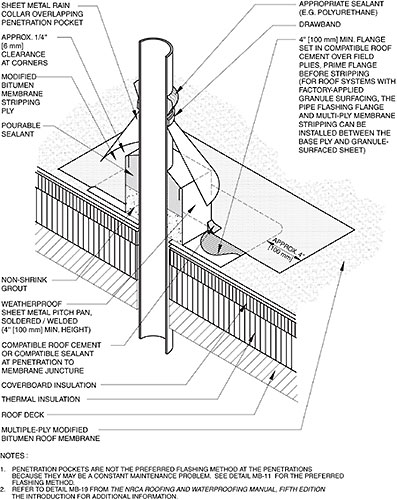
Detail MB-19 from The NRCA Roofing and Waterproofing Manual, Fifth Edition.
The NRCA Roofing and Waterproofing Manual, Fifth Edition, offers section and isometric details of penetration pockets for built-up, modified bitumen, thermoset and thermoplastic roof membrane systems. NRCA's detail MB-19, "Penetration Pockets," provides visual information for constructing a penetration pocket in a modified bitumen roof system.
All these details incorporate the use of a sheet-metal rain collar overlapping the pocket.
Penetration pockets primarily are used when a penetration's shape cannot properly be flashed and counterflashed with appropriate materials or when economics dictate a simple solution.
NRCA's manual specifically states, "Penetration pockets are not the preferred flashing method at the penetrations because they may be a constant maintenance problem." Improper maintenance or a lack of maintenance inevitably will lead to water infiltration and leaks. Most roof system manufacturers take exception to penetration pockets in their warranties.


COMMENTS
Be the first to comment. Please log in to leave a comment.