
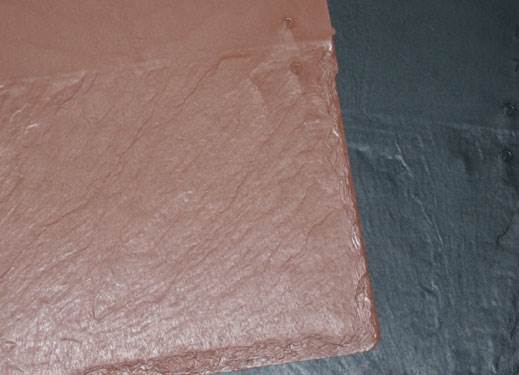
 Photo courtesy of Royal Building Products, Woodbridge, Ontario
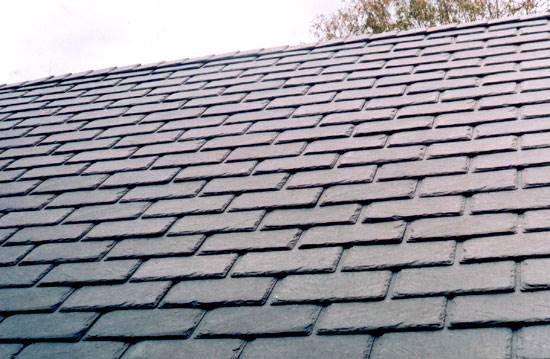 Photo courtesy of Crowe Building Products Ltd., Hamilton, Ontario


If you have visited model homes or attended building product shows recently, including the 2005 International Roofing Expo, you might have noticed many building material manufacturers have begun to produce "synthetic replicas" of traditional building materials, including wood siding, fencing, decking, dimensional lumber for fascia and soffits, architectural millwork, tile, brick, stone and roof coverings. And some of these manufacturers have seized the opportunity to focus on synthetic products that imitate traditional high-end steep-slope roofing products, including natural slate, cedar shingles and shakes, and clay and concrete tile.
Webster's II New College Dictionary defines "synthetic" as "artificial" or "manmade." For the purposes of this article, "synthetic" as it pertains to steep-slope roofing materials refers to manufactured products that replicate asphalt shingles, concrete and clay tile, metal panels, slate, and wood shakes and shingles that contain recycled plastic and/or rubber as a key ingredient.
Synthetic roof coverings are making a presence in the roofing market because of several factors. These include the ongoing efforts of various recycling organizations and energy-conservation groups to cut down on landfill waste and reduce manufacturing energy costs. The recycling effort, coupled with the maturity of thermoset and thermoplastic polymer technology, has provided an abundance of recyclable raw materials used to manufacture synthetic roof coverings. An informal survey I conducted in March of seven synthetic roof covering manufacturers shows recycled plastic and rubber materials account for 60 percent to 90 percent by weight of finished synthetic products.
Background
Synthetic roof covering products date to 1993—one manufacturer claims to still use its original formulation. The processes used to manufacture synthetic roofing products vary, including injection molding, extrusion molding and die-pressing. Synthetic roof coverings are produced in a myriad of locations in the United States and Canada, and the packaging and pallet configurations used by several manufacturers allow more roof coverings per pallet to be shipped than shipments of traditional roof coverings. Finished materials are available through building material distributors located throughout North America.
Advantages
There are several noteworthy advantages to using steep-slope synthetic roof coverings when compared with their traditional counterparts. For example, the actual weight difference between synthetic slate products and natural slate can be substantial. Synthetic slate weighs about one-third the weight of natural slate. The reduction in product weight allows synthetic slate to be installed over conventional substrates without an allowance for increased structural loading.
Another advantage is how the products are shipped. Most synthetic products are produced in individual pieces, but some are produced as panels combining several pieces into a larger unit. Panel products could improve installation production. Several manufacturers claim a labor savings because special tools are not required to cut their products. One manufacturer that ships its product in panels claims up to a 50 percent labor savings when its product is installed compared with the cost of installing individual natural pieces.
Several synthetic cedar shake and shingle manufacturers also claim labor savings because crews will not have to apply fire-retardants or anti-algae coatings. A number of their products advertise fire ratings ranging from Class A to Class C as determined by Underwriters Laboratories Inc.
In addition, most of the synthetic product literature I reviewed promotes the products' hail-impact resistance. A number of manufacturers note their products provide Class 4 hail protection. Several manufacturers even state homeowners who use their products could qualify for lower homeowner insurance rates. A number of synthetic roof covering manufacturers also state in their literature their products resist mold, mildew and insect attack.
A spot check of product prices reveals many synthetic roof covering producers have priced their products to be slightly less than their natural competitors. These same manufacturers also provide material warranties (limited and prorated) for certain products up to 50 years.
In addition, several synthetic slate products look convincingly like their natural competitors. In side-by-side comparison tests, the only way to distinguish among products is by touch. Several synthetic cedar shake manufacturers are even producing random widths similar to aged cedar shakes.
Disadvantages
Despite the benefits of synthetic roofing materials, some drawbacks are evident. For example, most synthetic roof coverings are manufactured using dyes or coloring agents to achieve a desired color and brightness. But what is unknown is whether the products will experience color fading from sunlight and weathering.
In addition, it is unknown whether synthetic products will become brittle and less flexible over time. Brittleness and decreased flexibility obviously could affect hail-impact resistance, as well as a product's response to occasional foot traffic.
Another issue is how synthetic products respond to wind. Although many synthetic roof coverings are said to be wind-resistant, there are no consensus standards for the testing of these types of products.
Installation
Recommended manufacturer installation methods for synthetic roofing products tend to be similar to installation methods for traditional roof coverings with a few idiosyncrasies, including several cautions regarding the use of pneumatic nail guns and guide markings for exposure and alignment.
One manufacturer cautions in its literature to bend its synthetic shingle to create a slight upward bow before placing the shingle on a substrate. Several manufacturers' application instructions specifically state a definitive minimum measurement when butting pieces side by side. Exposure dimensions for most synthetic products mirror traditional products.
Technical evaluation
Evaluating a finished synthetic steep-slope roof covering material from a technical basis can be difficult. The 2003 International Building Code (IBC) does not recognize any synthetic roof coverings currently available. IBC Section 1506.3, "Material specifications and physical characteristics," states: "Roof-covering materials shall conform to the applicable standards listed in this chapter. In the absence of applicable standards or where materials are of questionable suitability, testing by an approved agency shall be required by the building official to determine the character, quality and limitations of application of the materials."
Almost all the synthetic roof covering manufacturers I interviewed referenced third-party evaluation reports. Unfortunately, the evaluation reports provided by various synthetic roof covering manufacturers revealed these producers do not test similar-looking products with a uniform battery of tests.
For example, asphalt manufacturers wishing to introduce a new shingle can follow ASTM D225, "Standard Specification for Asphalt Shingles (Organic Felt) Surfaced with Mineral Granules," or ASTM D3462, "Standard Specification for Asphalt Shingles Made from Glass Felt and Surfaced with Mineral Granules," test methods. Clay roof tiles shall conform to ASTM C1167, "Standard Specification for Clay Tiles." Slate producers will follow ASTM C406, "Standard Specification for Roofing Slate."
What is needed to legitimize these synthetic roof coverings is for synthetic roof covering manufacturers to reach a consensus through an organization such as ASTM International. This is necessary so roof system designers, roofing contractors and end users can evaluate and compare several similar synthetic roof covering replications with a specific set of test methods.
What's ahead
The rubber taken from car and truck tires currently is being used as an ingredient in the manufacturing of some synthetic roof coverings. Polymer technology dramatically has improved during the past several decades, and production processes constantly are improving to selectively sort and blend these recycled materials with binders and fillers into viable compounds. Technological advancements will continue to improve the physical properties of finished synthetic roof coverings as they have improved thermoplastic and thermoset low-slope roof coverings.
The use of steep-slope synthetic roof coverings manufactured from recycled material can contribute to energy and/or tax credits for building owners. The ultraviolet inhibitors and specialty dyes used to color and stabilize these products also will permit roof covering manufacturers to produce roof systems with increased solar reflectance and meet ENERGY STAR® compliance.
The ecological attributes and environmental advantages of these products will give roof system designers more "earth-friendly" alternatives to consider for steep-slope roofing solutions. The increased use of synthetic roof coverings may help reduce landfill costs and energy consumption and provide a new classification of steep-slope roof coverings.
Chuck Scislo is an NRCA senior director of technical services.


COMMENTS
Be the first to comment. Please log in to leave a comment.