
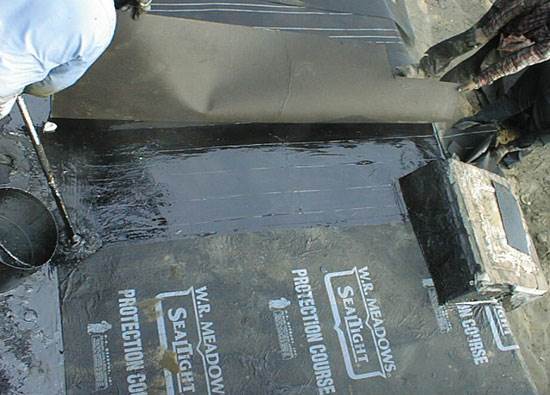
 Photo courtesy of Honeywell Commercial Roofing Systems, Cary, N.C.
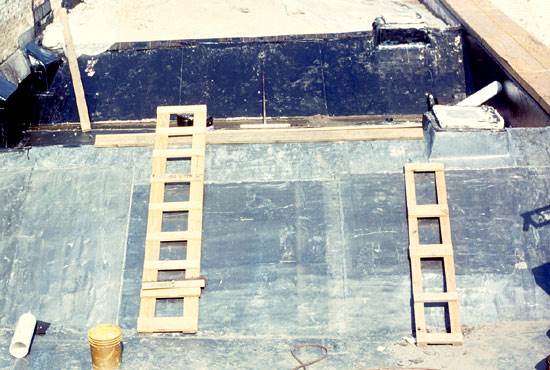 Photo courtesy of Honeywell Commercial Roofing Systems, Cary, N.C.
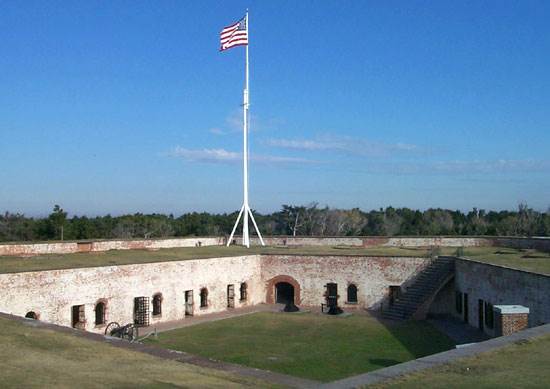 Photo courtesy of Honeywell Commercial Roofing Systems, Cary, N.C.


The pirate Blackbeard passed through it in 1718. The Spanish plundered it in 1747. The British captured it in 1782. The Confederates occupied a fort protecting it in 1861. Federal forces took the fort back in 1862.
The hot commodity is Beaufort Inlet, the entrance to Beaufort Harbor, one of North Carolina's major deep-water ocean ports. After years of hostile takeovers, the U.S. government realized it needed to establish a coastal defense to protect Beaufort and other coastal towns and entryways that encountered similar attacks. Therefore, during the early 1800s, several forts were built along the Eastern Seaboard.
After constructing two failed forts on Bogue Banks, an island outside Beaufort Inlet, the government completed Fort Macon in 1834 to guard the inlet and harbor (the first fort never was finished, and the second deteriorated and washed away). Fort Macon was built by the U.S. Army Corps of Engineers and named after Nathaniel Macon, an eminent North Carolina statesman.
Although Fort Macon has been repaired and renovated throughout the years, its infrastructure was damaged from water that penetrated the ceilings, walls and floors of the casements, or fortified "rooms" that comprise the fort.
In 1999, the North Carolina Division of Parks and Recreation embarked on a four-year, $12.3 million project to renovate the fort. The project was completed and dedicated in April 2003.
The first phase of the project involved asking a roofing contracting company to do something unusual.
"We usually put on roofs," says Prentiss Baker, president of Baker Roofing Co., Raleigh, N.C. "This was a waterproofing job at ground level."
Baker Roofing was asked to waterproof the underground casements' ceilings. The work area was at a high part of the fort where guns were mounted. Obviously, the fort's "roofs" are different than those roofing contractors typically encounter because they are buried underground. Baker Roofing was selected to work on the project after the original roofing contractor backed out.
"I guess the contractor started and quit," Baker explains. "But I don't know why."
In addition to Baker Roofing's task, the renovation project consisted of replacing 350,000 pounds (158760 kg) of lead sheeting and improving drainage systems. In addition, six casements were rehabilitated to include exhibits; millwork was reconstructed; and bronze stair railings and iron hinges were replaced. Repairs also were made to the parade grounds, sally-port and bridge entrances, plaster areas and gun mounts. To accommodate the 1.3 million annual visitors, the parking area was expanded.
Waterproofing
Baker Roofing worked on the project for about six months during 1999. Dirt and landscaping were removed from the casements to expose concrete slabs covered with lead sheeting. The general contractor repaired the concrete and lead as needed. After the general contractor's work was done, Baker Roofing installed Honeywell's Black Armor coal-tar-pitch waterproofing membrane system on top of the lead sheets, and the general contractor replaced the landscaping. Three casements were exposed at a time, and Baker Roofing worked on 11 casements. Six roofing workers installed 14,000 square feet (1301 m²) of waterproofing membrane.
"We would go to work for a week or two, and then, we'd break until the next area was ready to waterproof," Baker says.
Because the crew worked at or below ground level, fall protection and safety procedures typically used on a roof didn't come into play. Safety procedures instead centered on not damaging the fort. Roofing workers were careful not to get any roofing materials on the walls. In addition, the kettle and other materials couldn't be brought too close to the work area because of concerns about the fort collapsing from additional weight. Therefore, the kettle and materials were placed a good distance away from the work area, and roofing workers used tractors to transport materials or carried items by hand.
Baker adds: "We worked according to historical guidelines. We took extraordinary care not to damage anything." Although typical roofing safety procedures were not used on this project, worker safety still was a concern. Marines scanned the site for explosives to ensure no war remnants remained.
Because the project is on an island (with bridges at either end), the crew encountered typical coastal problems, such as high winds and sudden weather changes. Roofing workers also faced pests that usually aren't a concern.
"The mosquitoes were really bad," Baker says. "We don't usually get them high up on a roof."
Pride
While working on the project, Baker Roofing workers were surprised to learn the fort was so solidly built, considering it encountered 165 years of battles and harsh coastal weather. The April 2003 dedication ceremony let visitors see for the first time how the renovation project made the solid fort stronger and allowed the fort to tell its own story with new exhibits displayed in restored casements.
"Being part of a historical site is rewarding," Baker admits. "I'm a history buff. It's neat to be involved in bringing a site back to its original beauty."
It may seem strange that a roofing contractor was a major contributor to a project that took place on the ground.
But Baker explains, "It really is amazing to learn what you can do as a roofing contractor."
Kate Gawlik is associate editor of Professional Roofing magazine.
Project name: Fort Macon
Project location: Bogue Banks, N.C.
Project duration: Six months in 1999 (the entire renovation project was completed and dedicated in April 2003)
Roofing contractor: Baker
Roofing Co., Raleigh, N.C.
Installation type: Coal-tar-pitch waterproofing membrane System
Roofing manufacturer: Honeywell Commercial Roofing Systems, Cary, N.C.
General contractor: Thomas Simpson Construction, Morehead City, N.C.
Timeline
| 1756 | Construction of Fort Dobbs on Bogue Banks, N.C., begins during the French and Indian War but is not completed. |
| 1809 | Fort Hampton is built in the same location. |
| 1825 | Fort Hampton washes away because of storms and the shifting inlet. |
| 1826-34 | Fort Macon is constructed on Bogue Banks. |
| 1834-61 | Fort Macon is occupied by troops, engineers and ordnance sergeants. |
| 1840 | Robert E. Lee visits the fort to make structural repairs. |
| April 14, 1861 | The fort is seized by a company of local Confederate troops acting without state orders. Ordnance Sgt. William Alexander is the only man occupying the fort when it is seized. Confederates prepare the fort for battle, and about 900 men are stationed at the fort (the defense eventually is reduced to five companies). Fifty-four guns are mounted for defense. |
| March 1862 | Gen. Ambrose Burnside captures New Bern, N.C., and sends Brig. Gen. John G. Parke to capture Fort Macon. Parke captures Morehead City, N.C., and Beaufort, N.C., and entrenches his troops within 1,400 yards (1274 m) of the fort. |
| April 25, 1862 | Federal batteries open fire on the fort, and it eventually is captured. The fort is hit 560 times by artillery fire; seven Confederate soldiers are killed; 18 Confederate soldiers are wounded; one Federal soldier is killed; and three Federal soldiers are wounded. |
| 1862-76 | Federal forces occupy the fort and use it as a prison (no prison facilities existed in North Carolina or South Carolina during the Reconstruction). |
| April 1877 | Garrison troops withdraw. |
| 1877-98 | The fort is occupied by caretakers. |
| 1898 | The Spanish-American War causes the 3rd North Carolina Volunteers, an all-black regiment, to occupy the fort. |
| 1903-24 | The fort is abandoned. |
| 1924 | North Carolina acquires the fort from the federal government. |
| 1934 | Renovation work begins on the fort. |
| December 1941 | The 244th Coastal Artillery is stationed at the fort. The artillery is replaced by the 2nd, 54th and 246th Coast Artillery Regiments during World War II. The fort is leased by North Carolina to the U.S. Army. |
| 1945-present | Fort Macon is a state park open to the public. |
Fort designs
Fort Macon is pentagon-shaped—one side protects Beaufort Inlet; two sides guard the channel and back sounds; one side overlooks Beaufort Harbor; and another side covers beaches. A ditch separates the fort's outer line of defense, or covert way, and inner citadel. The covert way's wall is 12 feet to 15 feet (3.5 m to 4.5 m) high; the fort's outer wall is 24 feet (7 m) high; and the fort's inside wall is 17 feet (5 m) high. The tidal ditch is defended by four counterfire rooms in the covert way.
Including the sally port, there are 26 casements in the fort. To add strength, the casements' ceilings are arched. Each casement—or room—has fireplaces, two ventilation holes in the ceilings, and outer windows that acted as rifle loopholes and gun ports.
Because the fort is in a coastal area, drainage was a major consideration for the fort. Gutters in the walls channeled water into four large cisterns that could hold 22,000 gallons (83600 L). Soldiers could not drink the water because of seepage from surrounding salt water. (Drinking water wells were located outside the fort.) Five sewers or drains carried water to a central drain in the center of the parade ground that emptied into the ditch.
Powder and ammunition were stored in three magazines located behind stairways to provide additional protection. Bathrooms were located outside the fort, and soldiers also used the head of the marsh as bathrooms; the tide took excrement out to sea. Also located outside the fort were a hospital, stables, storage buildings, and quarters for officers and some married personnel.


COMMENTS
Be the first to comment. Please log in to leave a comment.