
The NRCA isometric flashing detail for thermoplastic membranes, TP-6 Base Flashing for Non-wall-supported Deck, sometimes is referred to as a field-fabricated "roof-to-wall" insulated expansion-joint detail. The detail shown is used where a structural roof deck is not supported by a perimeter wall. An example of this would be a steel frame building with precast "tilt-up" exterior walls.
This detail accommodates independent deck and wall movement. There are several necessary elements in this flashing detail to make it work successfully in the field. First, the thermoplastic base flashing sheet should not be adhered completely to the roof membrane or wall. Instead, the flashing sheet should be adhered to the wall and roof membrane up to where the sheet contacts the flexible foam rod. This allows the base flashing sheet to accommodate differential movement between the roof and wall. The flexible foam rod also acts as a water diverter, much like a cant, elevating the base flashing sheet in the corner to direct water away from the roof/wall intersection.
Another key element is installation of a flexible vapor retarder and compressible insulation. The primary purpose of insulation and a vapor retarder sheet is to limit heat loss and prevent moisture condensation. A secondary purpose of the sheet is to hold the compressible insulation in place and prevent it from sliding down the wall.
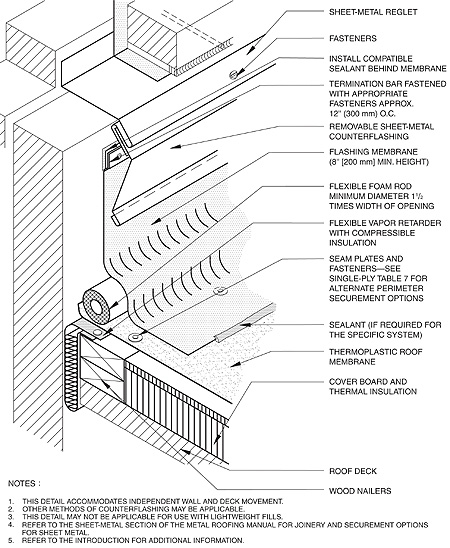
Detail TP-6 from The NRCA Roofing and Waterproofing Manual, Fifth Edition
Most thermoplastic roof membrane manufacturers offer field-fabricated and premanufactured "roof-to-wall" insulated expansion-joint details in their literature. A recent check of several thermoplastic membrane manufacturers' roof details showed that though they illustrate insulation at the "roof-to-wall" voids, none of these manufacturers show a vapor retarder.
NRCA recommends that when this detail is used on a roofing project, especially where conditioned space exists below, care should be taken to ensure a flexible vapor retarder is installed with compressible insulation.
Chuck Scislo is an NRCA senior director of technical services.


COMMENTS
Be the first to comment. Please log in to leave a comment.