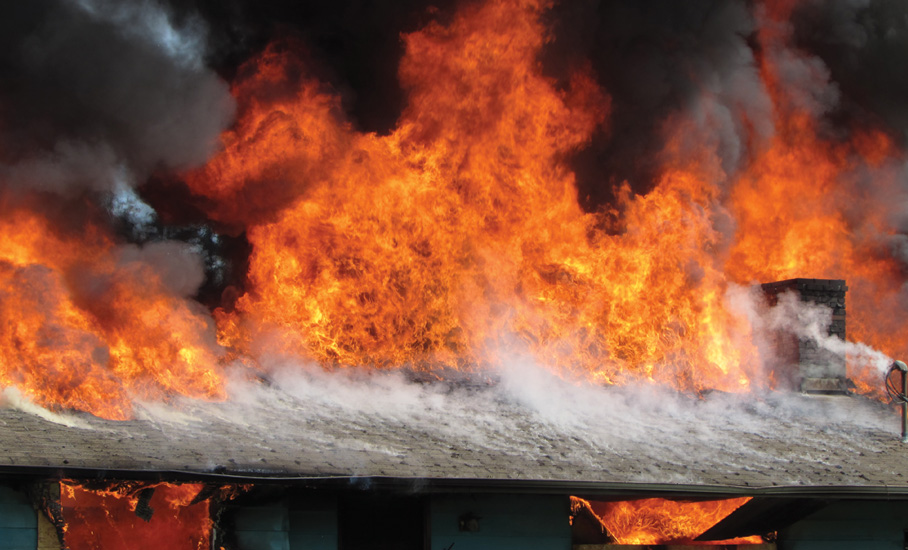
One of the many components of a properly installed roof system is its ability to resist catching fire. The International Building Code® and other organizations offer guidance and requirements for proper installation of fire-rated roof assemblies.
First, there are a few fire-related terms that need to be understood. The words “combustible” and “flammable” are sometimes used incorrectly or interchangeably but have two distinct meanings when used in building construction terminology. Combustible generally is defined as the ability to sustain a flame or burn when exposed to heat or fire. Flammable is generally defined as having a flash point of less than 100 F and being easy to ignite or catch fire when exposed to a spark or flame.
The terms are distinctly different when used to describe building or roofing materials. Wood board and/or plank and wood panel (plywood and oriented strand board) are combustible roofing materials. In addition, many common rigid board insulation products, including expanded and extruded polystyrene insulation, polyisocyanurate insulation and wood fiberboard insulation, are combustible.
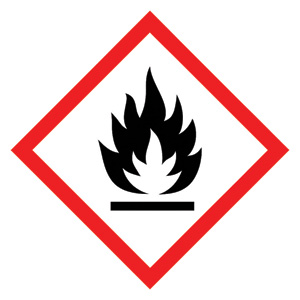
Some solvent-based membrane adhesives, low-rise foams, solvents, cleaners, and propane and similar gases are flammable. Flammable products typically carry hazard warning labels, similar to the one shown to the left, indicating their vapors can ignite easily. Flammable materials also often require additional controls during use, such as ventilation, ignition-source management, and adherence to Global Harmonized System or Department of Transportation fire-safety precautions found on the label and Safety Data Sheet.
IBC
Primary requirements for roof assembly fire ratings are contained in IBC’s Section 1505—Fire Classification. IBC defines the term roof assembly as a roof covering and roof deck or a single component serving as both the roof covering and roof deck. IBC states a roof assembly can include an underlayment, thermal barrier, insulation or vapor retarder. Other fire-related roofing requirements are in IBC’s Appendix D and in the International Wildland Urban Interface Code®; these only apply if specifically adopted by a local jurisdiction.
A roof assembly is classified as Class A, Class B, Class C or nonclassified. IBC’s Table 1505.1 contains the classification required for each type of building construction. Most construction types require a minimum Class B roof assembly with Class C being the minimum for others. Generally, no construction type requires a minimum Class A roof assembly unless required through adoption of the IWUIC or Appendix D.
There are nine building construction types: 1A, 1B, 2A, 2B, 3A, 3B, 4, 5A and 5B. IBC’s Chapter 6—Types of Construction specifies the requirements for each construction type. Each construction type must meet a minimum fire-resistance rating with two exceptions. Types 2B and 5B generally have no fire-resistant rating requirements for any structural element in a building.
For general reference, buildings constructed with concrete are considered Type 1 construction. Type 2 construction generally is steel-framed buildings. Buildings constructed with a mix of masonry and wood frame are Type 3 construction. Heavy timber construction, like that found in old warehouses, is Type 4 construction. And light-wood framing, such as 2x4s and 2x6s used in residential construction, is Type 5 construction.
For all three fire classifications of roof assemblies, the roof assembly and the roof covering are to be listed and identified by an approved testing agency
For roof construction and associated structural members, a fire-resistant rating of 1 to 1½ hours is required depending on the construction type except for Type 2B and Type 5B.
In accordance with IBC’s Table 1501.1—Minimum Roof Assembly Classification for Types of Construction, Types 1A, 1B, 2A, 3A, 4 and 5A require a minimum Class B roof assembly. Section 1505.3—Class B roof assemblies states: “Class B roof assemblies are those that are effective against moderate fire-test exposure.”
Types 2B, 3B and 5B require a minimum Class C roof assembly. Section 1505.4 states: “Class C roof assemblies are those that are effective against light fire-test exposure.” As previously mentioned, Class A roof assemblies are not required for any construction type. However, for reference, Section 1505.2 states: “Class A roof assemblies are those that are effective against severe fire test exposure.” In addition, Section 1505.2 permits Class A roof assemblies to be used for buildings or structures of any type of construction.
For all three fire classifications of roof assemblies, the roof assembly and roof covering are required to be listed and identified by an approved testing agency. An approved testing agency is one IBC defines as “an established and recognized organization that is regularly engaged in conducting tests, furnishing inspection services or furnishing product evaluation or certification where such organization has been approved by the building official.”
Section 1505.2 includes four Class A roof assembly exceptions:
- Those with coverings of brick, masonry or an exposed concrete roof deck
- Those with coverings of ferrous or copper shingles or sheets, metal sheets and shingles, clay or concrete roof tile or slate installed on noncombustible decks or ferrous, copper or metal sheets installed without a roof deck on noncombustible framing
- Those with coverings of minimum 16-ounce-per-square-foot copper sheets installed over combustible decks
- Those with slate installed with ASTM D226, Type II, “Standard Specification for Asphalt-Saturated Organic Felt Used in Roofing and Waterproofing,” or ASTM D4869, Type IV, “Standard Specification for Asphalt-Saturated Organic Felt Underlayment Used in Steep Slope Roofing,” underlayment over combustible decks
IBC’s Section 1505.1 specifies the testing required to achieve a Class A, B or C roof assembly and roof covering must be done in accordance with ASTM E108, “Standard Test Methods for Fire Tests of Roof Coverings,” or UL 790, “Standard Test Methods for Fire Tests of Roof Coverings.” Both measure the surface spread of flame over a roof covering material or system and the resistance to fire penetration from the exterior to underside of a roof deck. For noncombustible roof decks, only a flame spread test is required. For combustible roof decks, in addition to the flame spread test, an intermittent flame and a burning brand test also are required.
Section 1505.1 also specifies fire-retardant-treated wood shakes and shingles be tested in accordance with ASTM D2898, “Standard Practice for Accelerated Weathering of Fire-Retardant-Treated Wood for Fire Testing.”
IBC also has a classification for roof coverings of “nonclassified roofing,” which it considers an “approved material that is not listed as Class A, B or C roof covering.” Similar to an approved testing agency, an approved material is one acceptable to a building official. IBC only permits nonclassified roofing materials on buildings with Group U occupancies with a 6-foot minimum separation from a roof’s leading edge. Examples of Group U occupancies are agricultural buildings, barns, carports, private garages, stables and, under certain conditions, greenhouses.
For UL and FM Approvals fire-related resources and the International Code Council’s additional code requirements, visit UL’s directory of fire-rated assemblies, FM Approvals RoofNav, and International Code Council’s additional non-fire-related code requirements.
Other guidance
Section R902—Fire Classification of the International Residential Code® only requires the installation of a Class A, B or C roof assembly in jurisdictions where required by local law or where the edge of a roof deck is within 3 feet of a lot line.
For specific roof covering or roof assembly classifications, consult the specific manufacturer. For FM-approved assemblies, Class A is preferred. However, as previously discussed, any approved testing agency or lab is permitted to test and classify a roof covering or system.
It is important to note a particular classification is only valid when assembled as listed for a specific cover, insulation, fastener, deck or structural substrate. Substituting materials or products not specially included in the listing is not permitted.

Glen Clapper, AIA, LEED, AP
Director of technical services
NRCA