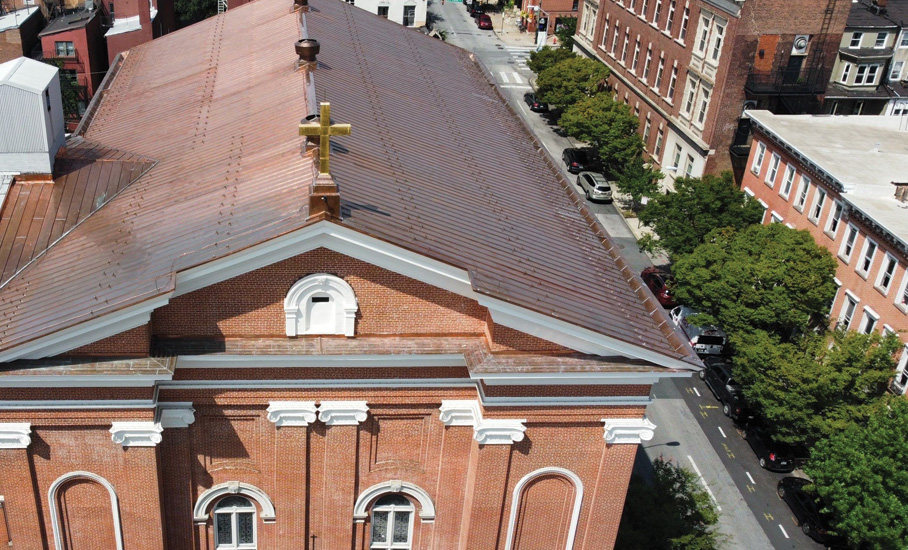
Constructed between 1853-56, St. Ignatius Church, Baltimore, is dedicated to Saint Ignatius of Loyola and serves as the chapel for Baltimore’s Loyola College. Architect Louis L. Long designed the structure in Italianate-style that features tall, frosted-glass windows with brick arches, heavy-modillioned cornicing and a broken pediment. The building’s base is rusticated, and the top is adorned with a golden cross.
The existing painted terne metal roof was deteriorating and near the end of its service life. The Fick Brothers Roofing Co., Baltimore, was selected by administrators to replace the aging roof on the historical building.
Scope and safety
In April 2023, The Fick Brothers Roofing team began work on the St. Ignatius Church project that included a new 20-ounce copper standing-seam roof system; new 24-ounce copper built-in gutters and downspouts; new 20-ounce copper cornice ledges and capital tops; new ground-level drain components; painting the existing roof vents; painting the main cornice, secondary cornice and rake trims; and installing lightning protection and snow-retention systems.
The roofing team was involved in the early stages of design and worked in conjunction with the project’s architect, Jim Suttner of Suttner Architecture LLC, Ruxton, Md., offering knowledge and input including pricing options and value engineering. Project specifications were developed, submitted and approved by the Commission for Historical and Architectural Preservation and Maryland Historical Trust.
“I worked closely with The Fick Brothers to evaluate various roofing material options,” Suttner says. “Several factors were considered including cost, longevity, durability, appearance and ease of maintenance. With The Fick Brothers help, standing-seam copper roof panels and flat-seam, fully soldered copper built-in gutters were chosen for the project.”
Scaffolding was erected on all sides of the building to provide fall protection and safe worker access. Multiple levels were constructed to reach the built-in gutter system at the roof edge and the cornice areas below the gutter.
The Fick Brothers team worked closely with Baltimore Gas and Electric Co. to safely build scaffolding adjacent to power lines on the property. Erecting the scaffolding in phases saved money while allowing crew members the opportunity to perform repairs and paint the fascia, soffit trim and window trim on the facades.
“The Fick Brothers helped strategize the coordination of working with other trades on the project, inspect the work and phase the scaffolding placement to avoid conflicts with holidays and other scheduled events,” Suttner says.
Gutter system
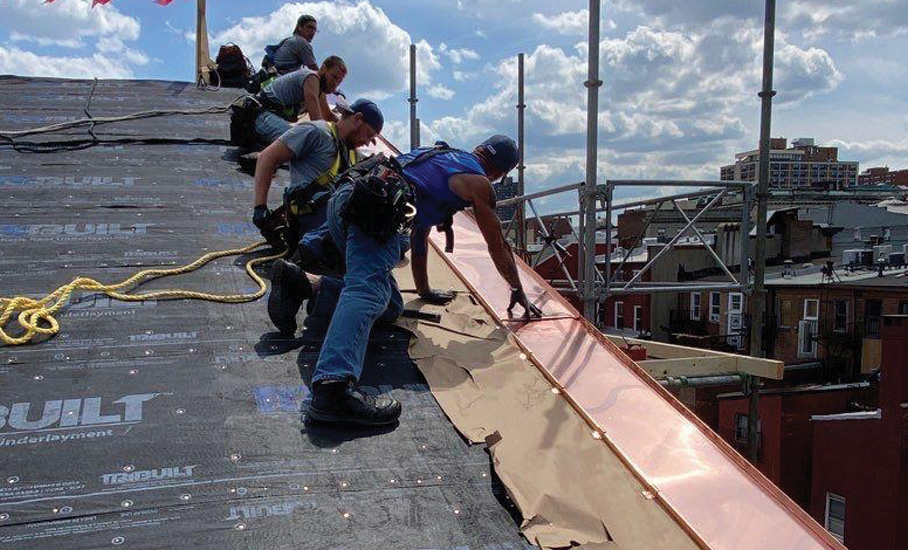
Team members removed the existing built-in gutters down to the wood substrate. Rotted wood was replaced with new lumber. To achieve proper drainage on the 14,735-square-foot roof, carpentry teams reconstructed the gutter framing to achieve a positive slope. The gutter’s wood substrate then was lined with Grace Ice & Water Shield® HT high-temperature self-adhering underlayment.
The Fick Brothers craftsmen custom-fabricated two new gutter outlets and installed them through the bottom of the gutter and through the cornice. The outlets emptied into new custom-fabricated 20-ounce copper conductor heads. A new 24-ounce copper gutter liner also was custom-fabricated in The Fick Brothers’ sheet-metal shop.
The gutter components consisted of four pieces: the gutter liner, a continuous cleat on the outer edge, an outer ledge cover and a transition piece that cleated the gutter to the roof eave. All gutter components were secured with copper nails, and all seams were riveted and soldered. Expansion joints were incorporated into the gutter design and were installed as needed between outlet locations.
“The Fick Brothers’ knowledge and experience was instrumental regarding the introduction, layout and design of proper expansion joints in the built-in gutters and snow guard solution,” Suttner says. “And they helped with technical details related to transitioning to other types of existing roofing materials and conditions.”
New 4-inch, round copper downspouts were installed from the conductor heads to ground-level drainage on a public sidewalk. The roofing team subcontracted with a plumbing contractor to design and install a new cast-iron drainpipe system under the sidewalk to connect to the city’s storm drains.
Roof installation
After the gutter system was installed, the roofing crew removed the existing standing-seam panels down to the wood deck. Rotted wood was replaced with new lumber. Workers then placed Grace Ice & Water Shield HT high-temperature self-adhering underlayment along the eaves and rakes and covered the entire roof surface with TRI-BUILT® Synthetic Underlayment followed by red rosin paper to prevent the 20-ounce copper panels from adhering to the underlayment.
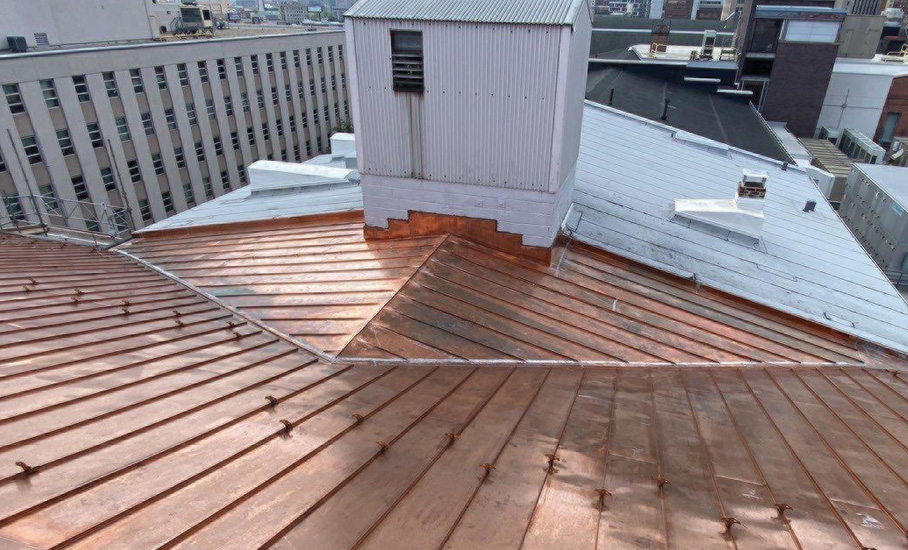
Craftsmen shop-fabricated new 20-ounce copper standing-seam roof panels on a roll-former machine. Custom crates were built to transport the 16-inch-wide panels with a 1 1/2 inch seam to the job site and lift them via crane to the roof.
The panels were installed and secured to the roof with clips spaced every 20 inches. Crew members used loose-lock cross seams for transverse seaming and staggered the end laps every other panel. The vertical seams were completed with a mechanical seamer to form the double-lock, standing-seam system. Copper valleys were attached with clips to the roof deck, and a continuous cleat was incorporated in the valleys so the standing-seam panels could be folded and locked onto the valleys.
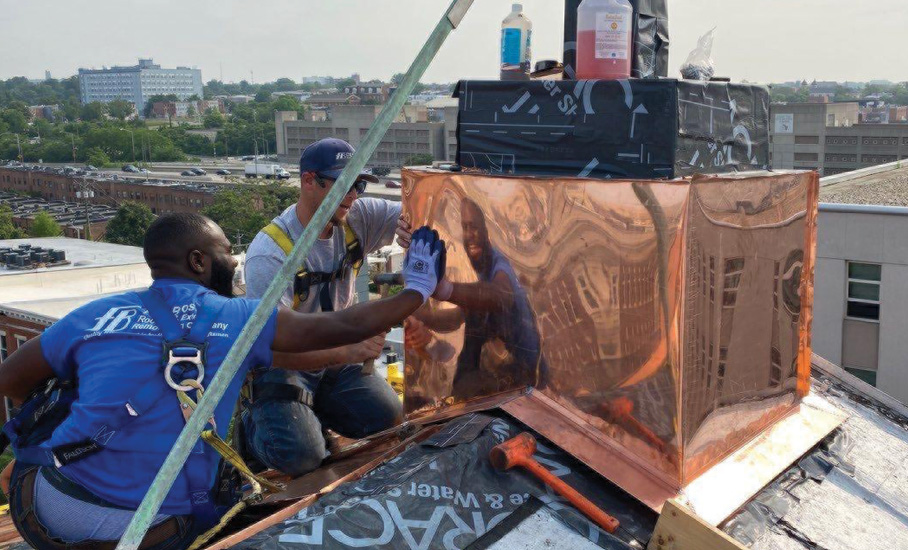
To complete the ridge, a new shop-fabricated copper ridge cap was folded and locked to Z-closures placed just downslope from panel ends and fastened to the roof deck. Z-closures also were used for the wall flashings and were counterflashed with separate pieces of copper flashing installed into a reglet at the masonry. Plumbing vent pipes were covered with two-piece copper flashing to allow for movement of plumbing pipes independent of the roof deck.
“During construction, the job site was always accessible to me for inspections, and The Fick Brothers included me in discussions to come up with solutions for field conditions,” Suttner says. “They had a tight urban site to work with and were well-organized.”
The team also installed a snow-retention system consisting of seam-mounted brass snow guards. Each row was staggered; one row was installed at the eave with another row about halfway up the roof. A single row was soldered to the center of each panel to prevent sliding ice.
“As one of the partners on this project, I witnessed firsthand how The Fick Brothers performed the installation with an outstanding level of workmanship and provided the highest quality roof system that will last for many decades,” Suttner says. “Dan Williams, The Fick Brothers’ project manager, was a pleasure to work with. He was knowledgeable, readily available and well-prepared to discuss matters on-site. He had a way of bringing his team together and focused on delivering high-quality results.”
A blessed ending
In October 2023, The Fick Brothers Roofing team completed work on St. Ignatius Church with no safety incidents. The project not only met but exceeded client expectations.
“The Fick Brothers Roofing team provided excellent service throughout the project,” Suttner says. “We collaborated to find a solution that was perfectly suited to the historical character of the building with many finely tuned details that were period-correct for the building. The standing-seam roof will last for generations, and The Fick Brothers team continues to have a presence with regular site inspections to ensure the roof stays in good shape. The client was happy with the results and are also happy to have a solid ongoing relationship with The Fick Brothers team.”
For its work on St. Ignatius Church, The Fick Brothers Roofing company was selected as a 2026 NRCA Gold Circle Awards finalist in the Outstanding Workmanship: Steep-slope category.
“It was rewarding to watch our team come together on such a large project and perform so well,” says James Fick, vice president of The Fick Brothers Roofing. “Nearly everyone in the company participated in this project on some level. Dan Williams, our project manager, is an expert in sheet metal. His knowledge and skills shined brightly on this project.
“Jim Suttner, the project’s architect, proved to be an excellent partner on this project from start to finish. We are honored St. Ignatius Church trusted The Fick Brothers to take on such a challenging and rewarding project. And thank you to NRCA for recognizing our company’s outstanding workmanship on the project. We look forward to the next opportunity!”
Project name: St. Ignatius Church
Project location: Baltimore
Project duration: April 2023-June 2023
Roofing contractor: The Fick Brothers Roofing Co., Baltimore
Roof system type: Architectural copper standing-seam panels
Roofing manufacturer: GCP Applied Technologies, Cambridge, Mass.; Owens Corning, Toledo, Ohio
Copper supplier: Revere Copper Products Inc., Rome, N.Y.

CHRYSTINE ELLE HANUS
Professional Roofing’s associate editor
Director of commmunications
NRCA